What is rice husk charcoal? Rice husk charcoal (also known as rice husk biochar) is a product obtained by pyrolyzing rice husks under oxygen-deprived conditions, which allows it to retain stable carbon and a porous structure. Unlike raw rice husks (unprocessed) or rice husk ash (from complete combustion), rice husk charcoal is a soil amendment that provides benefits for many years. This article will help you distinguish between these three materials, understand which one to use for what purpose, determine the proper application rate, and avoid common mistakes.
In the Mekong Delta, it is not uncommon to see rice husks being burned in the fields or large amounts of raw rice husks being mixed into vegetable beds, resulting in yellowing leaves and stunted growth. The cause often lies in the fact that three different materials are collectively referred to as “rice husks” and treated the same way.

Why do many farmers confuse rice husk charcoal, rice husk ash, and raw rice husks?
All three come from rice husks, and their colors are similar when mixed together in a half-burned pile, so they are easily confused. However, their different production methods result in completely different properties and uses.
Conditions: compacted, acidic, organic-poor soil
Many farming regions are facing problems with compacted, acidic, or saline soils that have become depleted and lack organic matter after many years of intensive cultivation. Such soils have poor water and nutrient retention, so farmers must apply more fertilizer without seeing a corresponding increase in yield. Adding durable, carbon-rich materials is an approach to improving soil quality that many gardeners are exploring.
Rice husks are abundant but are often wasted
Rice husks are a readily available byproduct in rice-growing regions. If they are burned outdoors or dumped into canals and waterways, they not only waste a carbon source but also cause smoke, dust, and water pollution. Properly converting rice husks into rice husk charcoal helps transform this byproduct into a valuable soil amendment.
Using the wrong type: actual damage
- Mixing large amounts of raw rice husks into the soil without adding nitrogen can cause a temporary nitrogen deficiency in plants.
- Applying large amounts of rice husk ash to alkaline soil can further increase the soil’s pH.
- Applying raw rice husk charcoal that has not been enriched with nutrients can slow plant growth in the early stages.
As a result, it’s a waste of time and money on fertilizer, and it’s easy to mistakenly conclude that this material is “ineffective.”
What Is Rice Husk Charcoal? Definition, Production Process, and Effects on Soil
Definition: Pyrolysis of rice husks under oxygen-deprived conditions
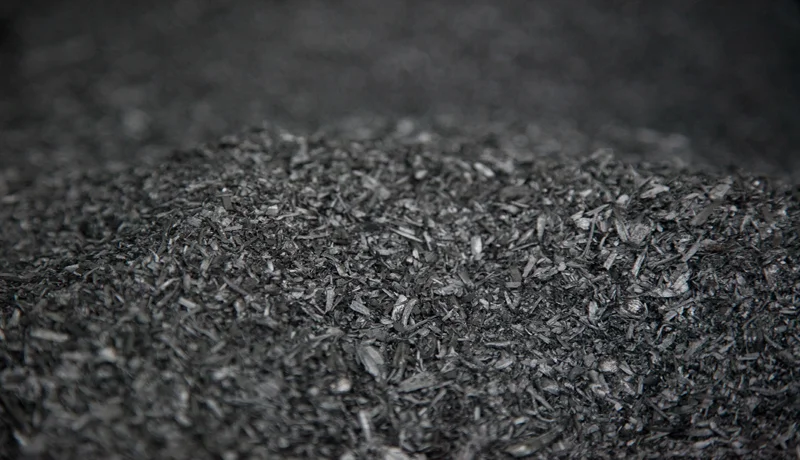
Rice husk charcoal is a type of biochar. Rice husks are typically heated to approximately 350–600°C In an oxygen-limited environment (pyrolysis process), it does not burn to ash but is carbonized. A high-quality product is uniformly black, light, brittle, and free of a pungent smoky odor. If you’d like to learn more about this technology, you can read the article How do pyrolysis, gasification, and carbonization differ?. A general overview of this material is presented in the article What Is Biochar?: A Comprehensive Guide.
Porous Structures and Microorganism Habitats
During pyrolysis, water and volatile substances are released, leaving behind a network of very small pores with a large surface area. These pores retain water and air, while also serving as a habitat for beneficial microorganisms around the root zone. Its durable structure means it does not decompose as quickly as typical organic materials.
CEC and Nutrient Retention Capacity
Cation exchange capacity (CEC) indicates a soil’s ability to retain nutrient ions such as ammonium, potassium, and calcium. The CEC of rice husk charcoal is typically moderate, and increases gradually as coal is "fed", that is, mixing it with organic fertilizer or composting it with microorganisms. The specific values depend on the pyrolysis temperature and the raw materials, so the manufacturer must provide test results.
Long-term carbon sequestration
The carbon in rice husk charcoal is in the form of aromatic compounds; it is very stable and can persist in the soil for many years. That is why biochar is considered a sustainable soil-improving material, unlike raw rice husks, which decompose fairly quickly and release carbon back into the atmosphere. You can learn more in the article A scientific explanation of the benefits of biochar.
Distinguishing Between Rice Husk Charcoal, Rice Husk Ash, and Raw Rice Husk: What Are the Differences?
Quick Comparison Chart
| Criteria | Raw rice husks | Rice husk charcoal | Rice husk ash |
|---|---|---|---|
| The Creation Process | Do not process | Anaerobic pyrolysis (approximately 350–600°C) | Complete combustion with plenty of oxygen |
| Color | Natural Brown Gold | Evenly black | Off-white or light gray |
| Carbon | Organic, biodegradable | Many, in a stable form | Very few, almost none left |
| Silicon | Yes, it doesn't dissolve easily | Yes, keep it within the coal structure | Very high concentration (usually very high, possibly over 80%), more soluble |
| pH | Near-neutral to slightly sour | Usually slightly alkaline to alkaline | High alkali |
| Rate of decomposition in soil | Slow; requires microbial treatment | Very slow, lasts for many years | Non-biodegradable (already mineralized) |
| Main Uses | Mulching, composting, bedding | Soil improvement, growing medium, moisture retention, fertilizer retention | Adds silica; slightly reduces acidity |
| Risks of Improper Use | Competition for nitrogen with plants | Nutrient absorption if not yet ingested | Make the soil more alkaline |
Raw rice husks
Raw rice husks are loose and crumbly, inexpensive, and readily available, but they have a high C:N ratio. When mixed directly into the soil, the microorganisms that break down the rice husks will “compete” with the plants for nitrogen, causing a temporary nitrogen deficiency. Therefore, raw rice husks are suitable for mulching, bedding, or composting, you should not mix too much into the soil before adding nitrogen.
Rice husk ash
Rice husk ash is what remains after rice husks have been completely burned; it is very rich in silicon but contains almost no stable carbon and has a high pH. Small amounts can be used as a source of silicon or to correct slightly acidic soil, but it cannot be substituted for rice husk charcoal in its role in improving soil structure.
Rice Husk Charcoal and How to Identify It Visually
Rice husk charcoal has stable carbon and a porous structure, making it long-lasting. A quick way to identify it: color jet black is rice husk charcoal, colored off-white ash, color brownish-yellow It is raw rice husk. If the pile of charcoal has black, gray, and still-yellow patches, the burning process was uneven and the quality is inconsistent.

The Practical Benefits of Rice Husk Charcoal for Soil and Crops
Effectiveness depends on soil type, crop, coal quality, and application method. You should monitor the following metrics: soil moisture, pH, EC, yield, and fertilizer costs per crop season.
Moisture-retaining, loose, and breathable
The porous structure helps the soil retain water better and remain more aerated. This effect is usually most noticeable in sandy soil and gray, depleted soil; in heavy clay soil, charcoal helps make the soil looser, but it must be mixed in thoroughly.
Retain manure and reduce runoff
Once enriched with nutrients, rice husk charcoal can help retain some nitrogen and potassium in the root zone, thereby helping to reduce fertilizer use. Don’t stop applying fertilizer immediately: reduce it gradually and monitor the results over each growing season.
Adjusts pH and helps bind certain heavy metals
Because charcoal is slightly alkaline to alkaline, it can help raise the pH of acidic or saline soil. This should only be done after measuring the soil’s pH. Charcoal can also somewhat limit the mobility of certain heavy metals, but it is not a solution for heavily contaminated soil.
Supplies silicon and supports the root microbiome
Natural rice husks contain silica, and rice husk charcoal retains some of it. Combined with the space provided by the porous structure, the root zone typically offers more favorable conditions for beneficial microorganisms. Article on The role of biochar and organic fertilizer Analyze this relationship in detail.
Step-by-Step Guide to Using Rice Husk Charcoal and Reference Dosage Chart
Steps to Follow
- Test the pH and determine the soil type. Sandy soil, gray soil, clay soil, and acidic soil each require different application rates and treatment methods.
- Select the appropriate particle size. Small, fine granules are suitable for growing media and vegetables; larger granules are suitable for fruit tree planting holes.
- Load the coal before applying fertilizer. Mix the charcoal with well-rotted manure, organic fertilizer, or microbial products, and let it sit for about 1–2 weeks to allow it to become moist.
- Mix thoroughly into a 10–20 cm layer of soil. Avoid spreading charcoal on the ground, as it can easily be blown away by the wind or washed away by water.
- Monitor and take notes. Record moisture levels, pH, plant growth, and fertilizer application rates to adjust for the next growing season.
Reference Dosage Table
| Target Audience | Materials | Recommended Dosage | How to Fertilize | Note |
|---|---|---|---|---|
| Garden land, vegetable-growing land | Rice husk charcoal has been loaded | Approximately 0.5–2 kg/m² (ranging from a few metric tons to about 10–20 metric tons per hectare, depending on soil conditions and investment capacity) | Mix thoroughly into the top 10–20 cm of soil when preparing the soil | Starting at a low level, gradually increasing by season |
| Fruit Trees | Rice husk charcoal has been loaded | About 1–3 kg per plant | Mix into the planting hole or apply in several applications around the root zone | Do not apply fertilizer right at the base of the plant; do not apply it all at once. |
| Potting mix | Rice husk charcoal | About 5–10% of the volume | Mix with soil, coconut coir, and organic fertilizer | Do not use too much, as it can make the growing medium alkaline. |
| Mulching, composting | Raw rice husks | Apply a 3–5 cm layer or let it decompose | Cover the rows or mix with fertilizer | Do not mix too much into the soil before adding nitrogen. |
| Silica Supplement, Acidic Soil | Rice husk ash | Small amount | Spread thinly, mix thoroughly | Avoid using on alkaline soil |
The recommended dosage is for reference only and should be adjusted based on soil test results, crop type, and coal quality. To select the appropriate dosage for a specific crop, you can refer to Reference Table for the C/N Ratio of Biochar by Crop Type.
Common Mistakes and Important Warnings When Using Rice Husk Charcoal
Warning: Rice husk charcoal is not a “fertilizer”; it is a soil conditioner. If used incorrectly, it may be ineffective or even counterproductive.
- Loading of unloaded raw coal. New charcoal can absorb some of the nutrients in the soil during the initial stage, causing the plants to grow more slowly. Solution: Always apply organic or microbial fertilizer before applying charcoal.
- Applying too much fertilizer at once. It can alter the pH, EC, and nutrient balance. It is recommended to apply it in multiple doses and increase the amount gradually.
- Do not measure the pH before applying fertilizer. Both charcoal and ash are alkaline; using them in soil that is already neutral to alkaline can make the problem worse. In particular, do not use rice husk ash as a substitute for rice husk charcoal in alkaline soil.
- Choose low-quality coal. Uncontrolled open-field coal burning can result in uneven pyrolysis, the presence of tar or impurities, and may even contain compounds such as PAHs.
Checklist for Selecting High-Quality Coal
- A uniform black color, with no significant amount of yellow rice husks or white ash mixed in.
- Lightweight, crisp, and crumbles easily when squeezed.
- There is no acrid smoke odor or smell of burning oil.
- There is information or test results regarding pH and EC.
Before implementing this on a large scale, please small-scale trial (a few rows or a few plants) and compare them with the control area where no charcoal was applied. If you need small bags for testing, you can refer to 5-kg bags of biochar made from rice husks.
Frequently Asked Questions (FAQ) About Rice Husk Charcoal, Rice Husk Ash, and Raw Rice Husk
Is rice husk charcoal the same as biochar, and how is it different from firewood or activated carbon?
Yes, rice husk charcoal is a type of biochar made from rice husks. Wood charcoal is typically used as fuel, while biochar is produced for use in soil. Activated carbon undergoes additional processing under specific conditions to increase its adsorption capacity; it is typically used for water filtration, not for widespread soil improvement.
Can rice husk ash be used instead of rice husk charcoal to improve soil?
It is not recommended. Rice husk ash is rich in silicon but lacks stable carbon and has a high pH, so it cannot form a porous structure or retain carbon as effectively as rice husk charcoal. It is only suitable for use in small quantities as a source of silicon or for mild acid neutralization.
How long does it take to see results from applying rice husk charcoal, and does it need to be reapplied every growing season?
Results are usually evident after 1–3 growing seasons, depending on soil type and how the charcoal is applied. Since the charcoal remains effective for many years, there is no need to reapply it in high doses each growing season; however, organic fertilizer and nutrients should still be added according to the plants’ needs.
Is it good to mix raw rice husks into the soil? Do they need to be composted before use?
Raw rice husks help loosen the soil but decompose slowly and may cause a temporary nitrogen deficiency. You should compost them or add nitrogen before mixing them into the soil, or use them to mulch around the base of plants to a depth of 3–5 cm instead of mixing in large amounts.
Summary and Tips for Selecting and Using Rice Husk Charcoal
In summary, once you understand what rice husk charcoal is, you’ll see that these three materials derived from rice husks serve different purposes:
- Raw rice husks: mulching, bedding, or composting.
- Rice husk ash: Add small amounts of silicon, and be careful with the pH.
- Rice husk charcoal: Sustainable soil improvement through stable carbon and a porous structure.
Pre-fertilization checklist: measure pH; determine soil type; select high-quality charcoal; mix charcoal with organic fertilizer or microbial agents; conduct small-scale trial applications; record results for each crop season.
BiocharVN supplies rice husk biochar produced in Dong Thap, suitable for both small gardens and farms. You can read more articles on how to apply biochar and compost with biochar to get it right from the very first growing season.