Heavy metals do not degrade like many organic compounds. When Pb, Cd, Cu, Zn, or Ni enter the soil, they can persist for decades, transitioning from the solid phase to the soil solution and then being absorbed by plant roots. Therefore, the practical goal of treatment is not merely to measure the “total metal content,” but rather to reduced solubility, exchange, and bioavailability may seep into plants or groundwater.
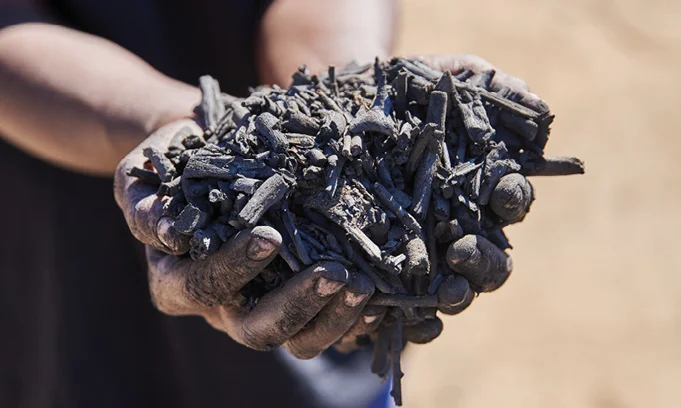
Phosphorus-modified biochar is a porous carbon material supplemented with phosphate, phosphoric acid, apatite, or phosphorus-containing compounds to enhance its metal-binding capacity. This material does not cause metals to disappear; it primarily converts mobile metal ions into adsorbed, complexed, or sparingly soluble phosphate mineral forms. Its effectiveness depends heavily on the type of metal, pH, form of phosphorus, biochar quality, and the characteristics of the soil or water stream being treated.
1. Why is phosphorus-modified biochar needed in pollution treatment?
The Effects of Pb, Cd, Cu, Zn, and Ni
Pb and Cd play no essential nutritional role for plants; they can be toxic even at relatively low concentrations and accumulate in the food chain. Cu, Zn, and Ni are trace elements required in small amounts but become toxic when levels exceed tolerance thresholds. Common symptoms include:
- Short, brown roots reduce the ability to absorb water and nutrients.
- Yellowing leaves, reduced photosynthesis, slow plant growth, or reduced yield.
- Decreased enzyme activity and soil microbial diversity.
- Metals accumulate in leafy vegetables, tubers, seeds, or irrigation water, posing long-term health risks.
The level of hazard is not simply proportional to the total concentration. Soil with a high total Pb concentration but where the Pb is bound in stable minerals may pose a lower immediate risk than soil containing less Pb but with an acidic pH and a high proportion of soluble Pb. Therefore, the decision on remediation must be based on Forms and bioavailability, rather than relying solely on a total metal result.
Limitations of Conventional Biochar
Unmodified biochar still possesses porosity, surface functional groups, and cation exchange capacity, but its effectiveness may be unstable when it comes to highly mobile metal ions. High-temperature pyrolyzed biochar typically has a high surface area and good carbon fixation, but it contains fewer oxygen-containing functional groups. In contrast, low-temperature pyrolyzed biochar has more functional groups but may have lower stability and porosity.
Phosphorylation provides an important mechanism: form complexes and precipitate sparingly soluble phosphate minerals. This is why the material typically shows a clear advantage over Pb, while the results for Cd, Cu, Zn, and Ni depend more on pH, ionic competition, and matrix composition.
Compared to soil washing, soil replacement, and chemical precipitation
Soil washing can remove some metals from the site but generates concentrated wastewater that requires treatment. Soil replacement provides quick results but involves high costs for excavation, transportation, and management of contaminated soil. Chemical precipitation is suitable for treating wastewater but requires control of pH, chemicals, and sludge.
Phosphorus-modified biochar is more suitable when needed Contain local pollution, to reduce uptake by plants or to serve as an adsorbent in a filtration column. This approach should be considered when contamination is widespread, concentrations do not warrant emergency excavation, and the site can be managed over the long term.
2. Through what mechanism does phosphorus-modified biochar adsorb heavy metals?
Adsorption within pores and on surfaces
Microporous and mesoporous structures, along with carbon defects, provide sites for metal ions to be held. Metals can diffuse into the pores, be attracted by electrostatic forces, or bind to carboxyl, hydroxyl, and phenolic groups. However, the pores should not be thought of as permanent lock-and-key sites: when the pH decreases, the ionic strength changes, or competing dissolved organic compounds are present, a portion of the metal may desorb.
Biochar produced in approximately 450–600°C typically provides a relative balance between porosity, carbon content, and surface functional groups. Fixed carbon content over 70% This may indicate a carbon-rich and stable material, but it does not automatically imply a high metal-holding capacity; it is still necessary to test the phosphate content, surface area, pH, EC, and conduct actual adsorption tests.
Formation of endogenous complexes and phosphate precipitation
The phosphate group can bind directly to metal ions on the surface, forming intramolecular complexes that are more stable than typical electrostatic interactions. Under suitable chemical conditions, phosphate reacts with the metal to form a sparingly soluble mineral phase.
With Pb²⁺, lead phosphate minerals similar to pyromorphite can form, such as Pb₅(PO₄)₃OH or Pb₅(PO₄)₃Cl. These phases have low solubility, thereby reducing the amount of dissolved Pb and allowing Pb to be extracted. Cd²⁺, Cu²⁺, Zn²⁺, and Ni²⁺ can also form phosphates or participate in coprecipitation, but their stability differs from that of Pb and is significantly influenced by pH and competing ions.
It is important to clearly distinguish between: Phosphate precipitation reduces mobility but does not reduce the total metal content in the soil. If the environment becomes highly acidified in the future, some of the minerals or surface complexes may still be re-dissolved.
Ion Exchange and Surface Charge
Biochar typically contains Ca²⁺, Mg²⁺, K⁺, or Na⁺ weakly bound to its surface. These ions can be replaced by Pb²⁺, Cd²⁺, or Cu²⁺. This process is called ion exchange and is related to cation exchange capacity, or CEC.
When the pH rises above the material’s neutral charge point, many functional groups lose protons, and the surface becomes more negatively charged, which facilitates the adsorption of metal cations. Conversely, at very low pH, H⁺ competes strongly with metal ions and can impair adsorption capacity.
Adjust pH and support the soil system
Many types of biochar contain alkali ash and carbonates, which can raise the pH of acidic soils. An increase in pH typically reduces the solubility of many metal cations through stronger adsorption and the formation of hydroxides, carbonates, or phosphates. Biochar can also improve moisture retention, provide habitat for microorganisms, and supply stable carbon.
However, not all biochar is alkaline. Material modified with phosphoric acid but not thoroughly neutralized may have a low pH. Applying too much alkaline biochar to neutral or alkaline soil can reduce the availability of Fe, Mn, and Zn and cause nutrient imbalances.
3. What metrics should be used to measure practical benefits?
Reduction in the bioavailability of the metal
The most significant results were reductions in metal concentrations in soil solution, the exchangeable fraction, relevant extracts, and plant tissue. Conclusions about effectiveness should not be drawn simply because total metal concentrations remain unchanged or because plants appear to grow better in the short term.
Key metrics to monitor include:
- pH and EC: detect changes in acidity, salinity, and the risk of root shock.
- Available phosphorus and soluble phosphorus: Assess nutritional adequacy and the risk of leakage.
- Metals dissolved or extracted using a suitable solution: reflects the relative flexibility.
- TCLP or an equivalent leaching test: Assess the risk of release under acidification conditions, particularly for post-treated materials.
- Metals in the roots, stems, and harvested parts: direct targets related to agricultural product safety.
- Biomass, toxicity symptoms, and yield: examine whether reducing metal content leads to improved growth.
Improve soil quality without replacing nutrient management
Biochar can increase water retention and cation exchange capacity (CEC) and reduce the leaching of certain nutrients. However, it should not be assumed that applying biochar will always reduce the amount of chemical fertilizer needed. Phosphate used as a soil amendment can serve as a source of phosphorus, but the rate of release varies among products. Fertilizer adjustments must be based on soil analysis, available phosphorus, and crop needs.
In phosphate-rich soils or near surface water sources, adding P may increase the risk of eutrophication. Conversely, phosphate can also bind with Ca, Fe, or Al, resulting in a lower-than-expected amount of P actually available for metal fixation.
4. Testing and Dosage Determination Guidelines
Step 1: Survey the soil or water
The minimum analysis should include target metals and total content, pH, EC, organic matter, soil texture, CEC, available phosphorus, and Ca, Mg, Fe, and Al ions, if feasible. For agricultural soils, samples should be collected from multiple locations and at various cultivation depths; a single sample should not be used to represent the entire area.
Step 2: Select materials with quality certificates
Prioritize biochar with traceable feedstock, clearly stated pyrolysis temperatures, and test results for heavy metals, PAHs, pH, EC, ash, fixed carbon, and total and soluble phosphorus content. Pyrolysis range 450–600°C It is generally suitable for screening, but the final product must be evaluated based on its actual performance.
Phosphate forms may include mineral phosphate, phosphate salts, apatite, or P added from a solution. Materials used in water must have adequate mechanical strength to prevent dust formation and filter column clogging.
Step 3: Test the dosage before a full-scale rollout
With soil, you can start pot experiments or propagation at the 0.5–5% dry weight. A 1% rate is equivalent to 10 g of biochar per 1 kg of soil. In field cultivation, the initial trial rate 3–5 metric tons per hectare It can be used for areas with mild contamination or for remediation trials, but the concentration is much lower than 0.5% when calculated for the entire 0–15 cm soil layer. Therefore, metric tons per hectare and mass percentages must be adjusted for depth, density, and the actual treatment area.
With water, the initial test volume is usually 0.5–10 g/L. It is necessary to establish a relationship between dose, exposure time, pH, and residual metal content rather than immediately selecting the highest dose.
| Application Environment | Initial trial dose | Particle size and time | Criteria for Adjustment |
|---|---|---|---|
| Slightly contaminated soil | 0.5–1% of dry matter or 3–5 metric tons per hectare | 1–5 mm; incubate for 2–4 weeks | pH, EC, available phosphorus, and metals in plants |
| Moderately contaminated soil | 1–3% of dry weight | 0.5–5 mm; cure for 4–8 weeks | Dissolved metals, exchangeable fraction, plant toxicity |
| Localized hotspot | 3–5% of dry weight | Blend thoroughly; monitor for at least 8 weeks | TCLP, leaching, pH after the wet–dry cycle |
| Plant growing medium | 5–10% of the substrate volume | 1–3 mm; moisten before planting | EC, pH, root growth, P, and micronutrients |
| Contaminated water in a test tube | 0.5–10 g/L | 0.25–2 mm; contact time 1–24 hours | Residual metals, turbidity, dissolved phosphorus |
| Flow-Through Filter Column | Determined based on load and residence time | Grains 1–5 mm; penetration test | Flow Rate, Pressure Drop, Outlet Concentration |
The intervals above are A screening dose, not a one-size-fits-all prescription for every situation. At least one untreated control plot and 3–4 treatment levels should be included. Moisten the biochar before mixing to reduce dust; mix thoroughly into the root zone or target soil layer, then maintain moisture while avoiding runoff that carries phosphorus away.
5. Common Mistakes and Safety Warnings
Using untested materials
Biochar derived from lacquered wood, sludge, mixed waste, or materials that have been exposed to chemicals may contain metals, salts, and toxic organic compounds. Products for which test results for heavy metals, PAHs, pH, and EC are not available should not be used in soil intended for growing food.
“Activation” does not necessarily mean it is safe. Chemically activated materials must be rinsed, neutralized, and tested for residuals. Raw biochar can temporarily absorb nutrients; moistening or pre-loading with clean compost or an appropriate nutrient solution should be considered, but phosphate should not be added indiscriminately if the soil already has excess phosphorus.
Over-fertilization or failure to account for ion competition
High doses can raise the pH and EC excessively, causing deficiencies in Fe, Mn, or Zn. Ca²⁺, Mg²⁺, dissolved organic matter, and many other ions compete for adsorption sites or react with phosphate. Therefore, the efficacy in pure laboratory water is often higher than in actual wastewater or soil.
No fixed durability test
Effectiveness should be reevaluated after heavy rain, wet-dry cycles, and pH fluctuations. For cultivated soil, testing can be conducted after 2–4 weeks, at the end of the first growing season, and periodically every 6–12 months. If the pH decreases or bioavailable metals increase again, the cause must be identified before applying additional fertilizer.
Biochar used to filter water with high metal concentrations must be collected. Do not spread this material on fields or add it to compost. Depending on the level of contamination and local regulations, it must be regenerated, further stabilized, or managed as contaminated material.
Frequently Asked Questions (FAQ)
Which metal is most effectively treated with phosphorus-modified biochar?
The effects are usually most noticeable with Pb This is due to the formation of lead phosphate, which is very slightly soluble. Cd, Cu, Zn, and Ni can still be retained through adsorption, complexation, or precipitation, but the results vary more significantly depending on pH and substrate composition.
Does biochar completely remove heavy metals from the soil?
No. Biochar is primarily bind and reduce bioavailability, rather than destroying or reducing the total metal mass. To remove metals from the site, it is necessary to combine excavation, soil washing, suction filtration, or biomass harvesting in a controlled process.
What is a safe dosage for plants?
You can screen 0.5–5% of the soil by weight, but the safe rate must be determined through pot or small-plot trials. Monitor pH, EC, available phosphorus, micronutrients, plant growth, and heavy metals in the harvested portion before scaling up.
How long should I wait before getting checked again?
pH and EC should be measured after 1–2 weeks; available metals and available phosphorus should be assessed after 2–8 weeks; plant tissue should be tested at harvest; and monitoring should be repeated after 6–12 months or following heavy rainfall.
Summary of the Mechanism and Implementation Recommendations
Phosphorus-modified biochar adsorbs heavy metals through four main mechanisms: adsorption in pores, ion exchange, surface complexation, and phosphate precipitation. The combination of these mechanisms can rapidly reduce the amount of dissolved metal, but long-term stability still depends on pH, phosphate form, competing ions, and hydrological conditions.
A reliable process always begins with a site analysis, followed by controlled trials at various dosage levels, and only then is it implemented on a large scale. Prioritize products with clearly identified ingredients, comprehensive testing records, and data specific to the type of soil, crop, or water body. This is a highly promising tool for stabilizing contamination, but it does not replace risk assessment and long-term environmental monitoring.


