Have you ever wondered why, despite applying enough fertilizer, crops remain stunted and leaves turn yellow? Mr. Minh, a rice farmer in Đồng Tháp, experienced this. Even though he regularly applied nitrogen fertilizer, rice yields did not improve. After an agricultural engineer inspected his fields, he learned the cause: the soil's C/N ratio was severely imbalanced. This is not just Mr. Minh's story but a common reality in many farming areas in Vietnam.
The C/N ratio (Carbon/Nitrogen ratio) is the "golden key" that determines fertilizer efficiency and soil health. When this ratio is not optimal, no matter how much fertilizer you apply, crops cannot absorb nutrients. In this article, we will help you understand what the C/N ratio is, why it matters, and most importantly — provide a detailed lookup table of Biochar C/N suitable for each crop type. You will gain scientific knowledge combined with practical experience to apply directly to your farming model.
What is the C/N ratio and why is it important in cultivation?
Definition of the C/N ratio in soil and organic materials
The C/N ratio is the proportion between the amount of Carbon (C) and Nitrogen (N) present in soil or organic materials. For example, if a soil sample has a C/N ratio of 20:1, it means that for every 20 parts of Carbon there is 1 part of Nitrogen. This is not just a number but also reflects the "health" and nutrient-supplying capacity of the soil.
Carbon is the main structural component of organic matter, providing energy for soil microorganisms. Meanwhile, Nitrogen is an essential nutrient element for crop growth, especially during the vegetative growth stage. The balanced ratio between these two elements determines the rate of organic matter decomposition and the ability to supply nutrients to plants.
The role of the C/N ratio in microbial activity
Soil microorganisms act like a "processing plant" that converts organic matter into nutrients plants can absorb. To function effectively, they need an appropriate C/N ratio — typically around 24:1 to 30:1 for optimal decomposition.
When the C/N is too high (much Carbon, little Nitrogen), microorganisms must "compete" with plants for Nitrogen to decompose organic matter. This phenomenon is called "nitrogen immobilization" — nitrogen in the soil is taken up by microorganisms, causing plants to become deficient even though the soil still contains nitrogen. Conversely, when the C/N is too low (little Carbon, much Nitrogen), decomposition occurs too quickly; excess Nitrogen will be leached or lost to the atmosphere as NH3 gas, causing waste and environmental pollution.
Direct impact of the C/N ratio on nutrient uptake
The C/N ratio directly affects three important factors:
Rate of nutrient mineralization: When the C/N is at an optimal level (10:1 to 12:1 for cultivated soils), decomposition proceeds steadily, releasing nutrients consistently for plant uptake. This helps plants grow continuously without interruption.
Fertilizer use efficiency: Soil with a balanced C/N ratio helps increase nitrogen fertilizer use efficiency by 20-30%. You will save significant fertilizer costs while still maintaining yields.
Soil structure and aeration: A proper C/N ratio promotes the activity of beneficial microorganisms, forms humus, and improves soil structure. The soil becomes more friable, retains water better, and creates an ideal environment for root development.
What is the optimal C/N ratio? A scientific analysis
Ideal C/N threshold for agricultural soils: 10:1 to 12:1
According to scientific studies and practical experience, the optimal C/N ratio for cultivated soils lies in the range 10:1 to 12:1. At this range, the soil can supply a stable amount of nitrogen to crops without nitrogen immobilization or nutrient losses.
For leafy vegetable soils, the ideal C/N ratio should be lower (8:1 to 10:1) because these crops have very high nitrogen demand. Meanwhile, perennial crops like coffee and rubber can tolerate a slightly higher C/N (12:1 to 15:1) due to their longer growth cycles.
High C/N (>30:1): Nitrogen immobilization and how to remedy it
When you apply materials with high C/N to the soil—such as fresh rice straw (C/N around 80:1), sawdust (C/N 200-500:1), or even some untreated biochar—nitrogen immobilization will occur. The most recognizable symptoms are yellowing leaves and slowed growth shortly after applying organic amendments.
Effective remedies:
- Supplement with nitrogen fertilizer (urea or well-composted manure) at a rate of 1–2 kg N per 100 kg of high C/N material
- Compost organic materials for 2–3 months before application to reduce the C/N ratio to 20–25:1
- Combine biochar with manure or green manure to balance the C/N ratio
- Apply at times when plants do not need much nitrogen (after harvest, during dormancy)
Low C/N (<20:1): Risk of nitrogen loss and environmental pollution
Materials with too low a C/N ratio, such as fresh chicken manure (C/N 6–8:1) or pig manure (C/N 5–7:1), cause many problems when applied directly. Nitrogen is released too quickly, exceeding the plants' uptake capacity. The excess is leached into groundwater (causing nitrate pollution) or volatilizes as ammonia gas (causing odor and nutrient loss).
In practice, at many integrated livestock–crop farms, applying fresh manure directly results in a 40–60% loss of nitrogen content, which is both wasteful and polluting. The best solution is to compost manure with straw or sawdust to raise the C/N ratio to about 25–30:1 before use.
Reference table of C/N ratios for common organic materials
| Material type | C/N ratio | Notes |
|---|---|---|
| Well-composted cow manure | 15-20:1 | Ready for direct application |
| Fresh chicken manure | 6-8:1 | Needs to be composted with straw |
| Dry straw | 80-100:1 | Supplement with nitrogen when applying |
| Sawdust | 200-500:1 | Only to be used after composting or converted to biochar |
| Green leaves | 20-30:1 | Suitable for green manure |
| Finished compost | 10-15:1 | Ideal for all crops |
| Rice husks | 40-80:1 | Good for improving soil structure |
| Bamboo biochar | 30-50:1 | Stable and long-lasting |
Biochar and its role in adjusting the C/N ratio in soil
What is biochar? Production process and characteristics
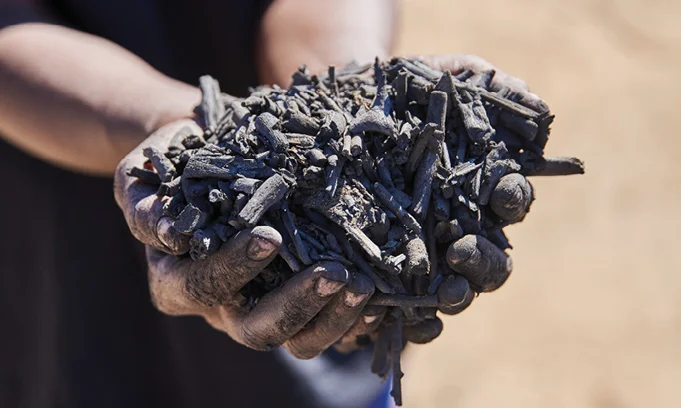
Biochar, also known as charcoal, is produced by the pyrolysis of biomass at high temperatures (300-700°C) under oxygen-limited or oxygen-free conditions. Unlike conventional burning, pyrolysis retains most of the carbon in a solid structure, creating a material with high porosity and a large surface area.
In Vietnam, biochar is often produced from agricultural residues such as rice husks, coffee husks, sawdust, corn stalks, bamboo branches, coconut shells... The production process can range from simple (improved traditional charcoal kilns) to complex (industrial pyrolysis furnaces).
Typical C/N ratios of biochar from different feedstocks
One notable characteristic of Biochar is its relatively high and stable C/N ratio, typically ranging from 30:1 to 100:1 depending on the feedstock and pyrolysis temperature. Biochar from wood and bamboo generally has a higher C/N (50-100:1), while Biochar from manure and bagasse has a lower C/N (20-40:1).
However, the carbon in Biochar exists in the form of "stable carbon" — not easily decomposed like carbon in conventional organic materials. Therefore, despite its high C/N, Biochar does not cause severe nitrogen immobilization as fresh straw or sawdust do. This is a major advantage of Biochar.
Mechanisms by which Biochar improves C/N balance and nutrient retention
Biochar acts as a "nutrient bank" in the soil thanks to three main mechanisms:
Adsorption and nutrient retention: Its porous structure with a large surface area (300-500 m²/g) helps Biochar adsorb nutrient ions such as NH4+, NO3-, K+, PO4³⁻. This prevents leaching and releases nutrients slowly according to plant demand.
Creating a habitat for microorganisms: The pores in Biochar are ideal habitats for beneficial microorganisms. Microbial density in soil with Biochar increases 10–100 times compared to regular soil, helping to enhance nutrient mineralization.
pH adjustment and improved CEC: Biochar often has an alkaline pH (7.5–9.5), helping to improve acidic soils — a common issue in Vietnam. At the same time, Biochar increases the soil's cation exchange capacity (CEC), enhancing nutrient retention.
Comparing the effectiveness of Biochar with traditional organic fertilizers
| Criteria | Biochar | Organic fertilizer (compost) |
|---|---|---|
| Longevity | 100-1000 years | 1-3 years |
| Direct nutrient supply | Low | High |
| Improves soil structure | Very good, long-term | Good, short-term |
| Water retention | Increases by 15-20% | Increases by 10-15% |
| Nutrient retention capacity | Very high (adsorption) | Medium |
| Initial cost | Higher | Lower |
| Long-term effectiveness | Very high | Requires frequent application |
Conclusion: Biochar and organic fertilizer do not replace but complement each other. The optimal solution is to combine both: biochar improves soil in the long term, while organic fertilizer provides immediate nutrients.
Reference table of optimal Biochar C/N ratios for each crop group
Staple crop group (rice, corn, tubers)
Soil C/N requirement: 10:1 to 12:1
Staple crops have a short cycle (3-5 months), with high nutrient demands concentrated during tillering and flowering. Maintaining a stable C/N helps provide a steady supply of nitrogen and prevents lodging caused by excessive nitrogen application.
| Crop type | Optimal soil C/N | Suitable biochar C/N | Biochar application rate | Application timing |
|---|---|---|---|---|
| Rice | 10-12:1 | 30-40:1 | 2-3 tons/ha/season | Apply before plowing, combined with manure |
| Maize | 11-13:1 | 35-45:1 | 2.5-3.5 tons/ha | Basal application before sowing |
| Sweet potato | 12-15:1 | 40-50:1 | 2-3 tons/ha | Basal application + one application after 30 days |
| Cassava | 15-18:1 | 45-60:1 | 3-4 tons/ha | One-time basal fertilization |
Important note: For rice, combine Biochar (C/N 30-40:1) with well-composted manure (C/N 15-20:1) at a 1:1 ratio to both improve the soil and provide nutrients. Supplement with 50-70 kg N/ha of nitrogen fertilizer during the tillering and heading stages.
Leafy vegetable group (water spinach, mustard greens, lettuce)
Soil C/N requirement: 8:1 to 10:1
Leafy vegetables have very high nitrogen demands to build green leaf biomass. Soil C/N should be lower than for other crop groups to ensure an abundant supply of nitrogen.
| Crop type | Optimal soil C/N | Suitable biochar C/N | Biochar dosage | Application timing |
|---|---|---|---|---|
| Water spinach | 8-10:1 | 25-35:1 | 1.5-2 tons/ha/season | Basal application + periodic nitrogen |
| Mustard greens | 8-10:1 | 25-35:1 | 1.5-2 tons/ha | Basal application, combined with liquid organic fertilizer |
| Lettuce | 9-11:1 | 30-40:1 | 2-2.5 tons/ha | Apply as basal dressing 7-10 days before planting |
| Amaranth | 8-10:1 | 25-30:1 | 1.5-2 tons/ha | Basal fertilization + watering with liquid organic fertilizer |
Special note: Biochar for leafy vegetables must be combined with readily available nitrogen sources (liquid organic fertilizer, nitrogen fertilizer). Recommended ratio: 1 part biochar + 2 parts well-composted manure. Apply diluted liquid organic fertilizer every 7–10 days to continuously supplement nitrogen.
Fruiting crops (tomato, chili, melon)
Soil C/N requirement: 10:1 to 13:1
Fruiting crops require different nutrient balances at different stages: more N during vegetative growth, more P and K during flowering and fruit set. A moderate C/N ratio allows flexible adjustment.
| Crop type | Optimal soil C/N | Suitable biochar C/N | Biochar dosage | Application timing |
|---|---|---|---|---|
| Tomato | 10-12:1 | 35-45:1 | 2.5-3 tons/ha | Basal application 2 weeks before planting; top-dress after 30 days |
| Bell pepper | 11-13:1 | 35-45:1 | 2-3 tons/ha | Basal application and top-dress at flowering |
| Cucumber | 10-12:1 | 30-40:1 | 2-2.5 tons/ha | Basal application combined with NPK fertilizer |
| Watermelon | 12-14:1 | 40-50:1 | 3-4 tons/ha | Apply basal fertilizer once; limit nitrogen during fruit set |
Fertilization strategy: Growth stage (0-40 days): Apply Biochar + manure + nitrogen fertilizer. Flowering and fruit set: reduce N, increase P and K, apply micronutrient fertilizers. Biochar helps retain nutrients and reduces the frequency of fertilization.
Industrial crop group (coffee, pepper, rubber)
Soil C/N requirement: 12:1 to 15:1
Industrial crops have long cycles, deep root systems, and require a stable soil environment. Biochar is particularly suitable because its effects last for decades.
| Crop type | Optimal soil C/N | Suitable biochar C/N | Biochar dosage | Timing of application |
|---|---|---|---|---|
| Coffee | 12-15:1 | 40-60:1 | 4-6 tons/ha (first application) | Before planting or when renovating an existing orchard |
| Black pepper | 13-16:1 | 45-65:1 | 5-7 tons/ha | Dig deep application trenches around the plant base |
| Rubber | 14-18:1 | 50-70:1 | 6-8 tons/ha | During plantation establishment |
| Cashew | 15-18:1 | 50-70:1 | 4-6 tons/ha | Basal application before planting |
Effective fertilization method: For already planted trees, dig trenches 30-40 cm deep at a distance of 50-80 cm from the trunk, mix Biochar with manure at a 1:1 ratio, and backfill with soil. A single application can remain effective for 5-10 years. Combine with annual NPK fertilizer according to the tree's needs.
Fruit tree group (orange, pomelo, mango, durian)
Soil C/N requirement: 11:1 to 14:1
Fruit trees have seasonal growth cycles; nutrient requirements change according to flowering, fruit set, and harvest stages.
| Tree type | Optimal soil C:N ratio | Suitable biochar C:N ratio | Biochar application rate | Application timing |
|---|---|---|---|---|
| Oranges, tangerines | 11-13:1 | 40-55:1 | 3-5 tons/ha/year | After harvest, before the rainy season |
| Pomelo | 12-14:1 | 45-60:1 | 4-6 tons/ha/year | Split into two applications: after harvest and before flowering |
| Mango | 12-15:1 | 45-60:1 | 3-5 tons/ha/year | After harvest |
| Durian | 13-16:1 | 50-70:1 | 5-8 tons/ha/year | Dormant growth stage |
| Longan, Lychee | 11-14:1 | 40-55:1 | 4-6 tons/ha/year | After harvest, combined with pruning |
Adjust according to the cycle: After harvest (May–July): Apply Biochar + manure to restore the trees. Flowering stage (Nov–Jan): Add phosphorus and potassium fertilizers, limit nitrogen. Fruit set stage (Feb–Apr): Apply balanced NPK fertilizer + micronutrients.
Guidelines for calculating and adjusting C/N when using Biochar
Formula for calculating mixed C/N when combining Biochar with organic fertilizers
When mixing several materials together, the C/N of the mixture is calculated by the formula:
Mixture C/N = (Total C) / (Total N)
Where:
- Total C = (Mass of material 1 × %C × C/N₁) + (Mass of material 2 × %C × C/N₂)
- Total N = (Mass of material 1 × %N) + (Mass of material 2 × %N)
Practical example: You have 100 kg rice husk Biochar (C/N = 40:1, %C = 40%) and 100 kg well-composted cow manure (C/N = 18:1, %C = 18%). Calculate the mixture C/N?
- C from Biochar = 100 × 0.4 = 40 kg
- N from Biochar = 40 / 40 = 1 kg
- C from cow manure = 100 × 0.18 = 18 kg
- N from cow manure = 18 / 18 = 1 kg
- Mixed C/N = (40 + 18) / (1 + 1) = 58 / 2 = 29:1
This result is suitable for composting or applying to perennial plants.
How to determine additional nitrogen needs when using high C/N Biochar
Simple rule: For every 1 ton of Biochar with C/N > 40:1, add 10-15 kg N (equivalent to 22-33 kg urea) to avoid nitrogen immobilization.
Detailed formula:
Nitrogen to add (kg) = (Biochar mass × %C) / 25
(The number 25 is the target C/N after balancing)
Example: Applying 2 tons of sawdust Biochar (C/N = 80:1, %C = 50%)
- N to add = (2000 × 0.5) / 25 = 40 kg N
- Equivalent to 87 kg urea (46% N) or 200 kg dry cow manure (20% N)
Simple home method to check soil C/N
No laboratory? You can still make a rough assessment of soil C/N using these signs:
Signs of high C/N (nitrogen deficiency):
- Plants with uniformly yellow leaves, slow growth
- Applied organic matter decomposes very slowly
- Light-colored soil, little humus
Signs of low C/N (excess nitrogen):
- Unusually dark green plants, soft stems and leaves
- Ammonia smell when digging the soil
- Pests and diseases thrive
Simple testing method:
- Take 1 kg of soil, mix thoroughly with 100 g of sugar (carbon source)
- Leave in a sealed bag for 3-5 days
- If there is a sour, fermented smell → low C/N (excess N)
- If there is no particular smell → balanced C/N
Common mistakes when applying Biochar
Mistake 1: Applying too much Biochar at once Many people think "the more the better" and apply 10-15 tons/ha on the first application. This causes waste and can make the soil too alkaline. Appropriate dosage: 2-5 tons/ha/year for short-cycle crops, 5-8 tons/ha for perennial crops.
Mistake 2: Using Biochar as a complete replacement for fertilizers Biochar is not a fertilizer but a soil amendment. You still need to apply NPK and organic fertilizers according to crop needs. Biochar only helps improve fertilizer use efficiency.
Mistake 3: Not "activating" Biochar before application Freshly produced Biochar has empty surfaces and has not adsorbed nutrients. You should soak Biochar in a liquid organic fertilizer solution or manure tea for 1-2 weeks before application to "activate" it.
Mistake 4: Applying Biochar in the dry season without irrigation Biochar needs moisture to work. Applying it in the dry season without irrigation will not be effective. Best timing: before the rainy season or when adequate irrigation is available.
Mistake 5: Leaving Biochar on the soil surface Biochar is light and can be blown away by wind or washed away by rain. Always mix Biochar into the soil at a depth of 10-20 cm to achieve maximum effectiveness.
Case studies and real-world results in Vietnam
Case study 1: Application of Biochar on rice in the Mekong Delta
Experimental trial in Dong Thap (2020-2022) comparing 3 treatments:
- Control: NPK fertilizer according to local practice (120-60-60 kg/ha)
- CT1: Rice husk Biochar 3 tons/ha + 20% reduction in NPK fertilizer
- CT2: Rice husk Biochar 3 tons/ha + manure 2 tons/ha + 30% reduction in NPK fertilizer
Results after 4 seasons:
- Yield: Control 5.8 t/ha, Treatment 1 (T1): 6.5 t/ha (+12%), Treatment 2 (T2): 6.9 t/ha (+19%)
- Fertilizer cost reduction: Treatment 1 saved 15%, Treatment 2 saved 25%
- Soil pH increased from 4.8 to 5.6 (improvement of acidic soil)
- Humus content increased by 35% compared to initial levels
Lessons learned: Combining biochar with organic fertilizer gives the best results. Pure biochar requires 2–3 seasons to fully take effect.
Case study 2: Central Highlands coffee with biochar from coffee husks
A coffee farm in Đắk Lắk (3 ha, 8-year-old trees) applied coffee-husk biochar (C/N 45:1) combined with manure.
Formula: 5 tons of coffee-husk biochar + 3 tons of well-composted cow manure/ha, applied once after harvest (June).
Results after 2 years:
- Yield increased from 2.8 t/ha to 3.4 t/ha (+21%)
- Percentage of uniformly ripe fruits increased by 15%
- Irrigation reduced by 30% thanks to improved soil moisture retention
- Fertilizer costs decreased by 40% (due to reduced application frequency)
- After 2 years, the soil became noticeably looser and roots grew vigorously
Advice from the farm owner: "Don't expect results in the first season. Biochar is a long-term investment. In the first year yield only increases by 5–7%, but from the second year onward you will see a clear difference."
Case study 3: Peri-urban safe vegetables with bamboo biochar
A safe-vegetable cooperative in Đà Lạt used bamboo biochar (C/N 35:1) for leafy vegetables and cabbage.
Procedure: Mix 2 tons of biochar + 4 tons of manure + 500 kg NPK fertilizer per 1,000 m² of soil. Apply as basal dressing 10 days before planting.
Results:
- Harvest time shortened by 3-5 days
- Yields increase by 18-25% depending on the vegetable
- Reduces nitrogen top-dressing fertilizer by 50%
- Vegetables are uniformly green and have fewer pests and diseases
- Easily meets VietGAP standards (low pesticide residues)
Experience: Bamboo Biochar has a high pH (8.5-9.0), very good for Đà Lạt's slightly acidic soils. However, be careful not to apply too much to avoid making the soil overly alkaline.
Biochar suppliers and quality selection criteria
Common types of Biochar on the Vietnamese market
Rice husk Biochar: Most common, inexpensive (1.5-3 million VND/ton), C/N 30-40:1, pH 7.5-8.5. Suitable for most crops. Drawback: medium durability, requires periodic replenishment.
Bamboo Biochar: High quality, C/N 35-50:1, pH 8.0-9.0, large surface area. Price 3-5 million VND/ton. Ideal for perennial crops and acidic soils.
Coconut shell Biochar: C/N 40-60:1, very good water retention, price 2.5-4 million VND/ton. Suitable for dry areas and fruit trees.
Sawdust Biochar: High C/N (60-100:1), needs to be combined with an N source. Cheap (1-2 million VND/ton) but requires careful treatment.
Manure Biochar: Low C/N (20-35:1), nutrient-rich, price 2-3.5 million VND/ton. Suitable for vegetables and short-duration crops.
Biochar quality standards to check
7-point checklist when buying Biochar:
- Clear origin: Know input materials and production process
- Moisture < 15%: Excessively moist biochar can mold and reduce quality
- Ash content < 30%: High ash = low carbon = poor effectiveness
- Particle size 2–10 mm: Too small blows away easily; too large is hard to mix evenly
- pH 6.5–9.0: Avoid too-high pH that causes nutrient imbalance
- No chemical odor: Quality biochar has a mild char smell, not pungent
- Uniform black color: No impurities, not burned to white ash
How to recognize low-quality biochar
- Gray or brown color: Low pyrolysis temperature; not fully carbonized
- Too light and crumbly: High ash content, low carbon
- Burnt, acrid smell: Contains tar and harmful compounds that haven't fully volatilized
- Mixed with honeycomb or regular charcoal: Not biochar, poor effectiveness
- Price too cheap (<1 million VND/ton): May be ash or waste charcoal, quality not guaranteed
Guide to producing biochar on a small scale
If you have readily available residues (rice husks, pruned branches...), you can easily make biochar yourself:
Two-layer metal drum method:
- Prepare 2 metal drums: 1 large drum (200 L), 1 small drum (100 L) with holes
- Put the feedstock into the small drum, place the small drum into the large drum
- Burn firewood outside the large drum; the heat will carbonize the feedstock in the small drum
- When the smoke changes from white to pale blue (after 2–3 hours), extinguish the fire
- Seal it and let cool for 12–24 hours
- Obtain Biochar at a yield of 20–30% of the original feedstock mass
Note: This method has low efficiency and uneven quality, but is suitable for household scale (under 100 kg per batch).
Conclusions and roadmap for effective Biochar application
Summary of key points on optimal C/N ratio
The C/N ratio is a determining factor for fertilizer use efficiency and soil health. The optimal C/N for soil ranges from 10:1 to 15:1 depending on crop type, while Biochar has a C/N of 30:1 to 70:1 but remains safe thanks to its stable carbon.
Biochar does not replace fertilizers but is a sustainable soil amendment that can increase fertilizer use efficiency by 20–40%, improve soil structure, retain water, and retain nutrients. Best results are achieved when Biochar is combined with organic fertilizer and NPK fertilizer according to the specific needs of each crop.
A 3-step roadmap for beginners to apply Biochar
Step 1: Assessment and planning (Month 1–2)
- Identify crop types, area, and current soil condition
- Look up the optimal C/N ratio and the appropriate Biochar dosage in the reference table
- Calculate costs and prepare a budget (Biochar + organic fertilizer + NPK)
- If possible, take soil samples for analysis at the agricultural extension station
Step 2: Small-scale trial (First season)
- Select one test plot (10–20% of the area) to apply Biochar
- Keep the cultivation method unchanged in the control plot
- Record details: application date, dosage, costs, growth status
- Monitor closely and adjust promptly if any issues arise
Step 3: Scale up and optimize (From the second season)
- Compare results between the test plot and the control plot
- If results are good (yield increase >10%, reduced fertilizer costs), expand gradually
- Adjust dosage and frequency based on practical experience
- Combine with other advanced farming practices (drip irrigation, IPM - Integrated Pest Management, etc.)
Trends in sustainable agriculture with Biochar in Vietnam
Biochar is being strongly promoted by the Government and agricultural organizations as part of strategies for sustainable agriculture and carbon emission reduction. Many projects support farmers' access to Biochar at preferential prices and provide free technical training.
According to the Soil and Fertilizer Institute, if 30% of Vietnam's cultivated area adopts Biochar, it could reduce 2–3 million tons of CO2 per year, while improving soil fertility and increasing yields by 10–20%. This is a great opportunity for farmers to both raise income and protect the environment.
Additional resources and supporting communities
- Website: National Agricultural Extension Portal (khuyennong.vn)
- Facebook page: "Biochar Việt Nam - Experience Sharing"
- Organizations: Provincial Agricultural Extension Centers, Soil and Fertilizer Institute
- Advisory hotline: District-level agricultural extension stations (free)
Take action today
Don't hesitate! Start by reviewing your current fertilization methods. Is the C/N ratio being monitored? Are you wasting fertilizer due to nutrient imbalances?
Select a small plot in your garden and test Biochar following the instructions in this article. Record observations carefully and compare the results. After 1–2 seasons, you'll be more confident to scale up.
If you found this article helpful, share it with your fellow farmers. Together, build a community of farmers who apply science and practice sustainable, efficient farming. Wishing you success!