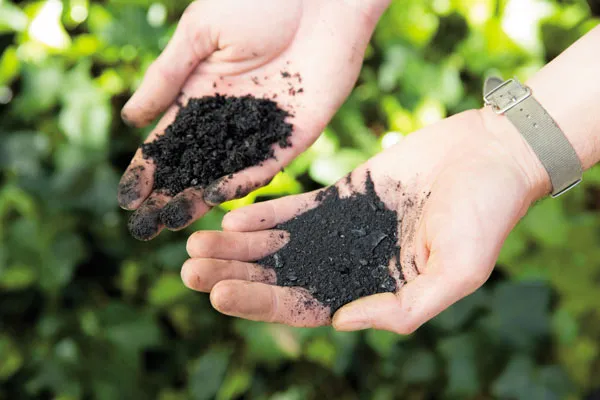
Mr. Nguyễn Văn Hùng, a coffee farmer in Đắk Lắk, once shared his regretful story: "I spent 15 million VND to buy 2 tons of cheap biochar from an unclear source. After six months of applying it to the soil, not only did yields not increase but the soil became harder and the plants wilted. Upon inspection I found that the product contained too high an ash content and heavy metals exceeding permissible limits." Hung's story is not an isolated case.
In the context of Vietnam's agriculture shifting towards sustainability, biochar (charcoal produced from biomass) has become and continues to be a soil improvement solution that many farmers and businesses are interested in. From the Mekong Delta to the Central Highlands, biochar is expected to help improve soil fertility, increase water-holding capacity, reduce dependence on chemical fertilizers and contribute to the net-zero emissions goal.
However, in practice, not every type of biochar is as effective as advertised. The current market is flooded with biochar products of uneven quality, ranging from internationally certified products to types that are merely ordinary charcoal labeled as biochar and sold at high prices. This not only wastes money but can also be counterproductive, degrading the quality of cultivated soil.
So how do you distinguish high-quality biochar from low-quality biochar? The answer lies in 8 key technical indicators that every farmer, agricultural engineer, and farm manager needs to understand before deciding to invest. This article will help you decode each indicator in an easy-to-understand way, along with practical guidance to choose the most suitable product for your land.
What biochar is and its role in improving agricultural soils
Definition of biochar and the biochar production process
Biochar is a solid carbon product produced by pyrolyzing biomass under oxygen-limited or oxygen-deficient conditions at temperatures between 300–700°C. Unlike ordinary charcoal burned for heat, biochar is produced primarily for soil amendment and long-term carbon storage.
Feedstocks for producing biochar are diverse, including paddy husks, rice hulls, sawdust, coffee husks, corn stalks, straw, fruit peels, and many other agricultural byproducts. The pyrolysis process is carried out in specialized kilns, which can be improved traditional kilns or modern industrial furnaces with temperature control and gas recovery systems.
How biochar works in agricultural soils
The special structure of biochar, with millions of tiny pores (from nano- to micrometers), creates an extremely large surface area—up to 300–500 m²/g. To visualize, just 1 gram of high-quality biochar has a surface area comparable to a small soccer field.
When added to soil, biochar acts as an ideal "home" for beneficial microorganisms, a "storehouse" for nutrients and water, and a "filter" that helps reduce fertilizer leaching. The stable carbon structure of biochar can persist in soil for hundreds to thousands of years, unlike typical organic fertilizers which decompose after only a few months.
Overview of benefits: From improving soil structure to increasing yield
Many studies in Vietnam and around the world have shown that biochar brings practical benefits:
- Improves soil structure: Increases porosity, reduces compaction, improves drainage in heavy soils and water retention in light soils.
- Enhances nutrient retention: Raises cation exchange capacity (CEC), reducing the need for chemical fertilizers by 20–30%.
- Regulates soil pH: Particularly effective on acidic soils, helping raise pH and reduce aluminum toxicity.
- Increases microbial biomass: Creates an ideal habitat for beneficial bacteria and symbiotic mycorrhizal fungi.
- Boosts yield: Trials have shown yields can increase by 10–30% depending on crop type and soil conditions.
- Reduces greenhouse gas emissions: Stores carbon in the soil, reducing N2O and CH4 emissions.
Why biochar quality determines 70% of its effectiveness
However, not all biochar delivers these benefits. Research shows biochar quality determines up to 70% of the effectiveness when applied to agricultural soils. A poor-quality biochar product may:
- Contains low carbon content, mainly inorganic ash that does not help improve soil
- Has a small surface area, insufficient ability to adsorb nutrients
- Contains heavy metals or toxic substances from poor-quality feedstock
- Has a pH that is too high or too low, not suitable for the soil to be amended
Therefore, understanding and checking biochar quality indicators before purchase is extremely important.
Indicators 1-2: Carbon content and C/N ratio - The foundation of high-quality biochar
Fixed carbon content: The first indicator to identify real biochar
Fixed carbon content is the most important metric to distinguish real biochar from regular charcoal or counterfeit products. This is the amount of stable, non-volatile carbon that makes up the majority of the mass of high-quality biochar.
Real biochar must have a minimum fixed carbon content 50% by dry weightPremium biochar products often reach 60-80% carbon. If a product has carbon content below 50%, it may be incompletely carbonized charcoal or a mixture of charcoal and ash.
Fixed carbon in biochar exists in the form of very stable aromatic structures that are resistant to decomposition by microorganisms. This is what allows biochar to store carbon in the soil for hundreds of years, while also creating its characteristic porous structure.
Minimum carbon threshold according to international standards (IBI, EBC)
International biochar standards organizations set specific thresholds:
- IBI (International Biochar Initiative): Requires a minimum organic carbon content of 10% and a C:ash ratio > 0.3
- EBC (European Biochar Certificate): Classifies biochar by grade: Premium (>50% C), Basic (>30% C)
- Vietnamese Standard (TCVN): Currently being finalized; refer to IBI with a recommended threshold >50% C
When purchasing biochar, you should ask the supplier to provide a certificate of analysis from a reputable laboratory, clearly stating the fixed carbon content. Do not trust advertising claims without technical evidence.
C/N ratio: The determining factor for nutrient retention
C/N ratio (Carbon/Nitrogen) is an index indicating the balance between carbon and nitrogen in biochar. This ratio determines whether biochar will supply nitrogen or compete with plants for nitrogen.
High-quality biochar should have C/N ratio > 25, ideally 30-100. Why is this number important?
- C/N too low (<20): Biochar will decompose quickly, release nitrogen too rapidly, reducing long-term carbon storage effectiveness
- Ideal C/N (30-100): Stable biochar, does not compete with plants for nitrogen, has good adsorption and nutrient retention capabilities
- C/N too high (>200): May cause temporary nitrogen deficiency for plants in the initial stages
For Vietnamese agricultural soils, biochar with a C/N of 40-80 is considered most suitable, especially for perennial crops such as coffee, pepper, and rubber.
How to check and request a carbon content certificate when purchasing biochar
When purchasing biochar, follow these steps:
- Request a laboratory analysis report with verification capability, clearly stating: total carbon content, fixed carbon, and C/N ratio
- Check the source of raw materials: Biochar from clean wood or rice husk often has a higher C/N than biochar from animal manure
- Visual inspection: High-quality biochar is glossy black, lightweight, retains the original feedstock structure, and does not crumble excessively
- Simple test: Place biochar in water; a good product will float or remain suspended, not sink quickly (due to its porous structure), and the water will not become too discolored
Indicators 3-4: Specific surface area and porosity - Nutrient-holding capacity of biochar
Specific surface area (BET): The golden standard indicator measuring adsorption capacity
Specific surface area (BET - Brunauer-Emmett-Teller) is the total surface area of all the pores in 1 gram of biochar. This is the "golden" indicator for evaluating the adsorption ability and nutrient retention of biochar.
Biochar with a larger surface area is more capable of:
- Adsorbing and retaining nutrient ions (NH4+, K+, Ca2+, Mg2+)
- Retaining water more effectively
- Providing habitat for microorganisms
- Adsorbing toxic substances and heavy metals in the soil
To illustrate: 1 gram of high-quality biochar with BET = 300 m²/g has a surface area equivalent to 1/10 of a football field. That is why only 5–10 tons of biochar per hectare can make a big difference in agricultural soil.
Ideal surface area threshold for agricultural soils (>150 m²/g)
According to international studies and recommendations:
- BET < 100 m²/g: Low-quality biochar, limited soil amendment effectiveness
- BET 100-200 m²/g: Medium-quality biochar, suitable for basic soil structure improvement purposes
- BET 200-400 m²/g: High-quality biochar, effective for agricultural soil amendment
- BET > 400 m²/g: Premium biochar, typically used for specialized purposes (pollution remediation, high-value crop cultivation)
For Vietnamese agriculture, biochar with BET of 150-300 m²/g is considered optimal in terms of effectiveness and cost. Biochar produced at 500-600°C from wood or rice husk feedstocks commonly reaches this range.
Pore structure (micropore, mesopore, macropore) and practical implications
Not only the total surface area, the distribution of pore sizes is also very important:
Micropore (< 2 nm):
- Accounts for most of the surface area
- Adsorbs small molecules and nutrient ions
- Retains water stably, less prone to evaporation
Mesopore (2-50 nm):
- Balances adsorption and transport
- An ideal habitat for microbes
- Holds plant-available water
Macropore (> 50 nm):
- Create space for plant roots and mycorrhizal fungi
- Aeration and drainage of excess water
- Habitat for small soil animals
Ideal biochar should have a balance between these three types of pores. Biochar produced at medium temperatures (450-550°C) typically has the most balanced pore structure.
The relationship between porosity and the soil's ability to retain water and nutrients
Research at Ho Chi Minh City University of Agriculture and Forestry shows that applying 10 tons of biochar/ha (BET = 250 m²/g) to sandy loam soil:
- Water retention capacity increased by 18–25%
- Reduced nitrogen leaching by 30–40%
- Reduced potassium leaching by 25–35%
- Increased fertilizer use efficiency by 20–30%
This means farmers can reduce chemical fertilizer and irrigation while maintaining or increasing yields. With current fertilizer prices, these savings can pay back the biochar investment in just 2–3 seasons.
Indicators 5–6: pH and CEC - Soil environment regulation capacity
pH of biochar: Why most biochar is mildly alkaline
pH is the measure of a biochar's acidity-alkalinity, ranging from 0–14 (7 is neutral). Most biochar has pH between 7.5–10, meaning it is mildly to moderately alkaline.
Why is biochar often alkaline?
- Pyrolysis produces alkaline metal oxides (K2O, CaO, MgO) from minerals in the biomass
- Aromatic carbon carries a negative charge, adsorbing alkaline metal cations
- Surface functional groups (carboxyl, hydroxyl) can neutralize acids
The pH of biochar depends on:
- Feedstock: Hardwood (pH 8–9), rice husk (pH 9–10), livestock manure (pH 8–10)
- Pyrolysis temperature: The higher the temperature, the higher the pH
- Residence time: Longer residence time produces biochar with higher pH
How to choose biochar suitable for each soil type (acidic soil, saline soil, acid sulfate soil)
Choosing biochar should be based on the soil's current pH status:
Acidic soils (pH < 5.5) - Common in the Central Highlands and Southeast regions:
- Choose biochar with pH 9-10 (from rice husk, bamboo)
- Dosage: 10-15 tons/ha to raise soil pH by 0.5-1 unit
- Benefits: Reduces aluminum toxicity, increases phosphorus availability
Neutral soils (pH 6-7.5) - Alluvial and gray soils:
- Biochar with pH 7.5-8.5 is suitable (from hardwood, sawdust)
- Dosage: 5-10 tons/ha to improve structure and retain nutrients
- Benefits: Increases CEC, improves soil porosity
Acid sulfate soils (pH < 4, containing acid sulfate) - Mekong Delta:
- Require high-pH biochar (>9) combined with lime
- Dosage: 15-20 tons/ha, applied in multiple splits
- Benefits: Neutralizes acidity, reduces Fe2+ and Al3+ toxicity
Saline soils (pH 7.5-8.5, high EC):
- Choose lower pH biochar (7-8) or washed biochar
- Dosage: 5-8 tons/ha
- Benefits: Improves structure, reduces the impact of salts
Cation exchange capacity (CEC): An index measuring the ability to hold nutrients
CEC (Cation Exchange Capacity) measures the ability of soil or biochar to hold positively charged ions (cations) such as NH4+, K+, Ca2+, Mg2+. Units are cmol(+)/kg or meq/100g.
Imagine CEC as the soil's "nutrient storage":
- High CEC = large storage, holds more fertilizer, less leaching
- Low CEC = small storage, fertilizers easily lost, requiring more frequent applications
High-quality biochar has CEC of 20-80 cmol(+)/kg, many times higher than sandy soil (CEC 2-5) and comparable to clay soils (CEC 20-40). When biochar is added to soil, the overall soil CEC will increase significantly.
Minimum CEC requirements and how biochar improves soil CEC over time
CEC requirements for agricultural biochar:
- Minimum level: 15 cmol(+)/kg
- Recommended level: 25-50 cmol(+)/kg
- Premium level: > 50 cmol(+)/kg
Notably, the CEC of biochar increases over time in soil — a phenomenon known as "aging":
- First year: Initial CEC of the biochar
- After 1-2 years: CEC increases 20-50% due to surface oxidation
- After 3-5 years: CEC can increase to twice the initial value
This process occurs due to:
- Surface oxidation creating additional acidic functional groups (carboxyl, phenolic)
- Interactions with soil organic matter and clays
- Microbial activity forming organic coatings on the biochar
Therefore, the effectiveness of biochar usually increases over time, unlike chemical fertilizers which have an immediate effect but wear off quickly.
Indices 7-8: Ash content and heavy metals - Product safety criteria
Ash content: An indicator of input material quality
Ash content is the residue remaining after complete combustion of biochar at 550-750°C. Ash mainly consists of mineral oxides (SiO2, CaO, K2O, MgO) that do not have the soil-improving capacity of carbon.
Ash content reflects:
- Quality of input feedstock (clean or mixed with soil/sand)
- Efficiency of the pyrolysis process
- Actual carbon content in the product
Biochar from different feedstocks has varying ash content:
- Clean wood: 2-8% ash
- Rice husk: 15-25% ash (due to high silica content)
- Sawdust: 5-12% ash
- Animal manure: 20-40% ash
- Straw: 10-20% ash
Maximum allowable ash threshold and harms of excessive ash
According to international standards and recommendations for agriculture:
Maximum ash threshold:
- IBI: < 60% by dry weight
- EBC Premium: < 20%
- Recommendation for Vietnam: < 30% (optimal < 20%)
Harms of biochar with excessively high ash content (>40%):
- Reduces useful carbon content, decreasing surface area
- Increases transport weight, raising logistics costs
- May contain heavy metals if the feedstock is contaminated
- Reduces effectiveness of soil remediation, increases cost per unit of carbon
- Can cause mineral imbalances in the soil if used at high doses
A small tip: If the biochar is light gray or off-white instead of glossy black, that's often a sign of high ash content. When rubbed between your fingers, high-ash biochar will leave a lot of light grayish-white dust.
Heavy metals (Pb, Cd, As, Hg): Potential hazards from low-quality biochar
Heavy metals are the most serious hazard of low-quality biochar. These metals do not break down, accumulate in the soil, are taken up by crops, and can harm human health.
Sources of heavy metals in biochar:
- Feedstock from painted wood, chemically treated wood
- Contaminated industrial residues
- Sewage sludge, municipal waste
- Biomass grown on contaminated land
Heavy metals of particular concern:
- Lead (Pb): Neurotoxic, affects children's development
- Cadmium (Cd): Causes kidney and bone damage
- Arsenic (As): Carcinogenic, causes skin diseases
- Mercury (Hg): Neurotoxic, affects fetal development
- Chromium (Cr): Causes allergies, cancer
Safety testing and quality certification requirements when purchasing biochar
Heavy metal limit thresholds according to international standards (mg/kg):
| Metal | IBI | EBC Premium | EBC Basic | TCVN Phân hữu cơ |
|---|---|---|---|---|
| Pb (Lead) | 300 | 120 | 150 | 500 |
| Cd (Cadmium) | 39 | 1.5 | 1.5 | 5 |
| As (Arsenic) | 100 | 13 | 13 | 50 |
| Hg (Mercury) | 17 | 1 | 1 | 5 |
| Cr (Chromium) | - | 90 | 90 | 500 |
| Ni (Nickel) | 420 | 50 | 50 | 200 |
| Cu (Copper) | - | 150 | 150 | 500 |
| Zn (Zinc) | - | 400 | 400 | 2000 |
Documents required when purchasing biochar:
-
Certificate of Analysis from an accredited testing laboratory, including:
- Carbon content, ash, pH, CEC (cation exchange capacity)
- Full heavy metals analysis
- Sampling date, analysis date (not older than 6 months)
-
Certificate of material origin: Confirmation that the material is clean and not derived from hazardous waste
-
Quality management system certification: ISO, HACCP, VietGAP (if available)
-
Usage instructions: Dosage, application method, suitable crop types
Warning: Never buy biochar from sources such as:
- Unknown material origin
- No certificate of analysis
- Unusually low price (< 50% of market price)
- Produced from industrial waste, sludge, or garbage
Practical guide: How to evaluate and choose high-quality biochar
Checklist: 8 indicators to request from the supplier
Before deciding to buy biochar, ask the supplier to provide information on the following 8 indicators:
☐ Indicator 1 - Fixed carbon content:
- Requirement: ≥ 50% (optimal 60-80%)
- Analytical method: ASTM D1762 or equivalent
☐ Indicator 2 - C/N ratio:
- Requirement: 30-100 (optimal 40-80)
- Ensure no nitrogen competition with crops
☐ Indicator 3 - Surface area (BET):
- Requirement: ≥ 150 m²/g (optimal 200-400 m²/g)
- Method: BET nitrogen adsorption
☐ Index 4 - Pore size distribution:
- Balance between micro-, meso- and macropores
- Total pore volume > 0.1 cm³/g
☐ Index 5 - pH:
- Suitable for soil type: pH 7.5-10 for acidic soils, pH 7-8 for neutral soils
- Method: pH meter in 1:20 solution
☐ Index 6 - CEC:
- Requirement: ≥ 25 cmol(+)/kg (optimal 30-60)
- Method: Ammonium acetate method
☐ Index 7 - Ash content:
- Requirement: < 30% (optimal < 20%)
- Method: ASTM D1762
☐ Index 8 - Heavy metals:
- All values must be below EBC Premium or IBI thresholds
- Full analysis: Pb, Cd, As, Hg, Cr, Ni, Cu, Zn
On-site preliminary biochar testing methods
You can perform preliminary checks of biochar quality with simple tests:
Test 1 - Visual inspection:
- Color: Glossy black, not gray-white
- Structure: Retains the original feedstock shape (wood grain, rice-husk shape)
- Breakage: Not too crumbly, little dust
- Contaminants: No soil, sand, or coal mixed in
Test 2 - Float test:
- Place a handful of biochar into water
- Good biochar: Floats or remains suspended, then slowly sinks as it becomes waterlogged
- Poor biochar: Sinks quickly (high ash content, low porosity)
Test 3 - Water color test:
- Soak biochar in water for 30 minutes, shake well
- Clear or light yellow water: Good biochar
- Dark black water with lots of dust: Poor biochar, high ash content or not fully carbonized
Test 4 - Sound test:
- Shake the bag of biochar or drop it from a height
- A crisp, tinkling sound: Good biochar, high porosity
- A dull, heavy sound: Poor biochar or high ash content
Test 5 - Hand rub test:
- Gently rub the biochar in your palm
- Leaves a clean black mark: Good biochar
- Leaves a lot of white-gray dust: High ash content
- Easily crumbles into powder: Biochar is overburned or poor quality
Test 6 - Simple pH test:
- Soak biochar in distilled water, measure with pH paper or a pH meter
- pH 7.5-9: Suitable for most agricultural soils
- pH > 10: Use caution on saline or alkaline soils
Certificates and documents required when buying biochar
When purchasing biochar, especially in large quantities (>1 ton), request:
1. Certificate of quality analysis:
- From an accredited testing laboratory (Institute of Soil and Fertilizer, Center for Technical Standards, Metrology and Quality)
- Includes all 8 parameters mentioned
- Analysis date within the last 6 months
2. Certificate of origin:
- Confirmation of raw material sources
- Production process
- Production location
3. Instructions for use:
- Recommended application rates by crop type
- Application methods (soil mixing, surface spreading, composting)
- Storage precautions
4. Management system certifications (if any):
- ISO 9001 (quality management)
- HACCP, VietGAP (food safety)
- Organic certification (if used for organic agriculture)
5. Clear sales contract:
- Quality commitment
- Return policy if specifications are not met
- Performance warranty (some reputable suppliers)
Price and quality comparison table: How much investment is reasonable
Biochar price framework in the Vietnamese market (2024):
| Category | Price (VND/kg) | Carbon content | BET (m²/g) | Suitable applications |
|---|---|---|---|---|
| Low-grade biochar | 3,000-5,000 | 30-45% | 50-100 | Basic soil structure improvement |
| Medium-grade biochar | 6,000-10,000 | 50-60% | 150-250 | Typical agricultural soil |
| Premium biochar | 12,000-18,000 | 65-80% | 250-400 | High-value crops |
| Premium biochar | 20,000-30,000 | >80% | >400 | Special applications, organic |
Estimated reasonable investment:
Example: 1 ha coffee plantation, acidic degraded soil
- Recommended dosage: 10 tons/ha premium biochar
- Cost: 10,000 kg × 15,000 VND = 150 million VND
- Transportation and application costs: 20 million VND
- Total investment: 170 million VND/ha
Expected benefits (according to research):
- Increase yield 15–20%: +300–400 kg coffee/ha/year
- Reduce chemical fertilizers 25%: Save 15 million VND/year
- Reduce irrigation 20%: Save 5 million VND/year
- Increase product value (organic): +10–15%
Payback period: 3–4 years (biochar effective for 10–20 years)
Common mistakes to avoid when buying biochar
Mistake 1: Focusing only on low price
- Too-cheap biochar often has high ash content and low carbon
- The cost per unit of carbon may actually be higher than for quality biochar
Mistake 2: Not checking certification documents
- Believing advertising and not requesting a certificate of analysis
- Buying biochar of unknown origin may contain harmful substances
Mistake 3: Buying biochar not suited to your soil type
- Using high-pH biochar on alkaline soils
- Using low C/N biochar for nutrient-poor soil
Mistake 4: Incorrect application rates
- Under-application: Ineffective
- Over-application: Wasteful, may cause nutrient imbalances
Mistake 5: Expecting immediate results
- Biochar needs time to interact with the soil (3–6 months)
- Best results from the second year onward
Mistake 6: Using biochar alone
- Should be combined with organic fertilizers and microorganisms
- Additional nutrient fertilizers should be applied (biochar is not a fertilizer)
Mistake 7: Improper storage
- Keeping biochar wet causes it to lose effectiveness
- When left exposed, soluble nutrients are washed away
Case study and recommendations for effective biochar application
Case study: Restoring coffee-growing soils in the Central Highlands with high-quality biochar
Background: Ea Kar coffee cooperative, Đắk Lắk - 50 ha of degraded basalt soil, pH 4.8, low CEC (8 cmol+/kg), yields have been declining over the past 5 years.
Implemented solution (2021-2023):
- Biochar used: From coffee husks, produced on-site
- Quality indicators: C = 68%, BET = 280 m²/g, pH = 8.5, CEC = 45 cmol+/kg, ash = 18%
- Dosage: 12 tons/ha, applied once at the start of the rainy season
- Combined with: Microbial organic fertilizer (2 tons/ha) + NPK fertilizer reduced by 30%
Results after 2 years:
| Indicator | Before | After 1 year | After 2 years |
|---|---|---|---|
| Soil pH | 4.8 | 5.4 | 5.7 |
| CEC (cmol+/kg) | 8 | 12.5 | 15.8 |
| Organic (%) | 1.8 | 2.3 | 2.9 |
| Yield (tons/ha) | 2.1 | 2.5 | 2.8 |
| A-grade kernel (%) | 45 | 52 | 58 |
| Fertilizer cost (million VND/ha) | 35 | 28 | 25 |
Economic benefits:
- Increased yield: +33% after 2 years
- Improved quality: +13% A-grade kernels, selling price up 8%
- Reduced fertilizer cost: 10 million VND/ha/year
- Additional income: ~45 million VND/ha/year
- ROI: Payback in 2.5 years
Farmers' comments: "Coffee plants are greener and healthier, with fewer yellow leaves and better drought tolerance. Importantly, the soil is loose and porous, retains moisture longer, and saves irrigation water."
Biochar dosage and application methods suitable for each crop
Recommended dosage table:
| Crop | Dosage (tons/ha) | Application method | Frequency |
|---|---|---|---|
| Coffee | 10-15 | Spread around the canopy, mix into soil 10-15 cm deep | Once every 3-5 years |
| Pepper | 8-12 | Mix into base soil, apply as basal dressing | Once every 3-4 years |
| Rubber | 12-18 | Apply in bands, mix into soil | Once every 5 years |
| Cashew | 8-10 | Spread around the canopy | Once every 3 years |
| Rice | 5-8 | Mix into soil before planting | Once every 2-3 crops |
| Vegetable crops | 3-5 | Mix into beds before planting | Each season or every other season |
| Fruit trees | 10-15 | Dig a trench around the canopy, mix into the soil | Once every 3-4 years |
| Flowers | 2-4 | Mix into the growing medium | Each season |
Effective application methods:
1. Basal application (before planting):
- Evenly spread biochar over the soil surface
- Mix evenly with the topsoil (15-20 cm)
- Moisten, leave for 1-2 weeks before planting
2. Top dressing (for established plants):
- Spread around the plant base (within the canopy)
- Loosen lightly and mix with the topsoil (5-10 cm)
- Irrigate after fertilizing
3. Apply in combination with organic fertilizers:
- Mix biochar : organic fertilizer = 1:2 or 1:3
- Keep moist for 2-4 weeks before application
- More effective than applying them separately
4. Use as a growing medium:
- Biochar : soil : organic fertilizer = 1:2:1
- For seedling propagation and potting
- Increases germination rate and seedling vigor
Combine biochar with organic fertilizer and microorganisms to maximize effectiveness
Golden combination formula:
Biochar + Organic fertilizer + Microorganisms = Maximum effectiveness
Each component plays a specific role:
- Biochar: Improves soil structure, retains water and nutrients, provides habitat for microorganisms
- Organic fertilizer: Supplies nutrients and increases biological activity
- Microorganisms: Decompose organic matter, fix nitrogen, and solubilize phosphorus and potassium
Biochar pre-composting process before application:
- Mix biochar with organic fertilizer (ratio 1:2)
- Apply a microbial solution (EM, Trichoderma, Bacillus)
- Stack to a height of 30-40 cm, cover with a tarp or straw
- Maintain moisture at 50-60% and turn the pile 1-2 times per week
- Incubate for 3-4 weeks; the biochar will be "charged" with nutrients and microbes
- Apply to the soil according to recommended rates
Benefits of biochar inoculation:
- Increases the CEC of biochar by 20–30%
- Microorganisms pre-colonized on the biochar
- Reduces the initial "nitrogen starvation" effect
- Delivers results 30–50% faster than applying unamended biochar
Specific formulation for 1 ha of coffee:
- High-quality biochar: 10 tons
- Microbial organic fertilizer: 3 tons
- Microbial inoculant (EM): 30 liters
- NPK reduced to 70% of normal
- Foliar fertilizer with added micronutrients
Long-term biochar investment roadmap for small and medium-sized farms
Phase 1 - Trial (Year 1):
- Select 1 representative area (0.1-0.2 ha)
- Invest in high-quality biochar at the correct dosage
- Monitor and record thoroughly
- Cost: 15-20 million (can request support from projects or authorities)
Phase 2 - Expansion (Years 2-3):
- If results are good, expand to 30-50% of the area
- Find a stable source of biochar at a good price (buy in bulk)
- Can produce biochar on-site from residues/by-products
- Cost: 50-100 million depending on area
Phase 3 - Comprehensive (Years 4-5):
- Apply to the entire area
- Develop standard procedures for the farm
- Integrate with VietGAP and Organic certification
- Cost: Decreasing due to self-production or wholesale purchasing
Phase 4 - Maintenance (From Year 6):
- Apply supplemental 3-5 tons/ha every 3-5 years
- Reap long-term benefits
- Share experiences, spread the word
Sources of funding support you can seek:
- Government sustainable agriculture projects
- Local agricultural extension programs
- Preferential loans from Ngân hàng Chính sách xã hội
- Support from non-governmental organizations (NGOs)
- Connect with companies that buy organic products
Conclusion: Smart investment in quality biochar - The key to sustainable agriculture
Summary of the 8 most important biochar quality indicators
To choose high-quality biochar, always check the 8 key indicators:
- Fixed carbon content ≥ 50% - Ensures this is true biochar, not regular charcoal
- C/N ratio between 30–100 - Does not compete with crops for nitrogen
- BET surface area ≥ 150 m²/g - Adsorption and nutrient retention capacity
- Balanced porous structure - Ideal environment for microorganisms and plant roots
- pH suitable for the soil type - Effectively improves soil pH
- CEC ≥ 25 cmol+/kg - Strong nutrient reservoir
- Ash content < 30% - Ensures high carbon content, clean feedstock
- Heavy metals within safe limits - Protects health and the environment
Final advice: Prioritize quality over low price to achieve long-term effectiveness
Biochar is a long-term investment, not a short-term expense. A high-quality biochar product can be effective for 10–20 years, while low-quality biochar may not only be ineffective but can also harm the soil.
Don't let a low price determine your choice. Calculate the cost per actual unit of carbon, per year of use, and per the benefits delivered. A product that costs twice as much but has three times the quality is still the smarter choice.
Always request a certificate of analysis from a reputable laboratory. This is the buyer's legitimate right and the seller's responsibility. If the supplier cannot provide it, find another source.
Biochar development trends and opportunities for Vietnamese agriculture
Vietnam has favorable conditions to develop the biochar sector:
- Abundant feedstock: 40–50 million tons of agricultural residues per year
- High demand for soil rehabilitation: Millions of hectares of degraded, acidic, and acid sulfate-affected soils
- Supportive policies: Strategies promoting green agriculture and emission reductions
- Growing organic agricultural market: Biochar is an important tool
- Carbon market: Potential to sell carbon credits from biochar
This is a golden opportunity for:
- Farmers: Sustainable soil restoration, increased income
- Businesses: Producing and marketing high-quality biochar
- Researchers: Developing technologies and standards suitable for Vietnam
- Government: Quality management and supporting farmers' access to technology
Call to action: Resources and where to find more information
Start your biochar journey today:
-
Check your soil: Contact your local agricultural extension center to analyze the soil and determine needs
-
Learn more:
- Website: International Biochar Initiative (biochar-international.org)
- Vietnam Institute of Soil Science and Fertility
- Provincial/municipal agricultural extension centers
-
Community connections: Join farmer groups using biochar, share experiences
-
Small-scale trials: Don't invest heavily right away; start small to learn
-
Request support: Contact agricultural extension agencies or sustainable agriculture projects for advice and support
Biochar is not a "silver bullet" that solves every problem, but when chosen with the right quality and used correctly, it is the key to unlocking the future of sustainable agriculture - where soils become more fertile, yields increase, and the environment becomes greener.
Start by understanding the 8 quality indicators of biochar. That's the first step to smart investment and successful harvests!