Composting Process Using Biochar for Healthy Plant Growth
In organic farming and home gardening, many people are familiar with compost as a natural source of nutrients that helps improve soil quality, increase organic matter, and support beneficial microorganisms. However, when compost is combined with biochar, the results often far exceed those achieved through conventional composting alone. This is why more and more people are learning about The composting process using biochar to make the most of agricultural byproducts, reduce input costs, and promote more sustainable crop growth.
Biochar is not a fertilizer in the traditional sense, but it acts as a “scaffold” that retains water and nutrients and creates a favorable environment for microorganisms to thrive. When mixed with compost, biochar is “enriched” with organic matter, nitrogen, minerals, and beneficial microorganisms. The result is a compost that is biologically active, crumbly, low-odor, more stable, and particularly beneficial for a wide range of soil types.
This article provides a detailed guide covering everything from preparing materials and mixing ratios to controlling moisture and temperature, as well as how to recognize when compost is fully decomposed and how to use it effectively for different types of plants.
Introduction to Biochar Compost and Its Benefits for Crops
Biochar is a type of charcoal produced by burning biomass under oxygen-deprived conditions, typically from rice husks, tree branches, sawdust, corn cobs, or other agricultural byproducts. What makes biochar unique is its porous structure, which contains numerous tiny pores. This structure enables it to absorb water, retain nutrient ions, and provide space for microorganisms to thrive.
When biochar is mixed into a compost pile, its role is not merely that of a bulking agent. Biochar acts as a substrate that helps limit nutrient leaching, reduces nitrogen loss, and improves aeration throughout the entire compost pile. As a result, the decomposition process proceeds more steadily, especially under hot and humid weather conditions or when the materials tend to become compacted.
For crops, compost biochar offers numerous overall benefits:
- Helps make the soil looser and more porous, especially for heavy clay soil or compacted soil.
- Improves moisture retention while maintaining the necessary aeration for the roots.
- Improves nutrient retention around the root zone, reducing the problem of over-fertilization with poor plant uptake.
- Supports the development of the soil microbial community, thereby improving the decomposition of organic matter and the mineralization of nutrients.
- Helps develop a stronger root system, making the plant more resilient to heat stress or short-term water shortages.
In other words, compost made from biochar not only nourishes plants in the short term but also helps build healthy soil in the long term.
Why should you mix biochar with compost instead of applying it directly?
Many people tend to apply biochar directly to the base of plants, believing it to be a beneficial soil amendment. In reality, raw biochar has very strong adsorption properties. If applied without first being moistened or “loaded” with nutrients, it can temporarily bind some of the nutrients already present in the soil or fertilizer, making it harder for plants to access them in the early stages.
That is why biochar should be composted or activated before use. During the composting process, the pores of the biochar gradually absorb water, humic acids, microorganisms, and nutrients from manure, grass, leaves, and other organic materials. At that point, biochar is no longer an “empty” material but becomes a biologically and nutritionally rich medium.
The benefits of mixing biochar with compost include:
- Reduces the risk of competition for nutrients with the crop during the early stages.
- Improve the utilization of nitrogen, potassium, and phosphorus in the compost pile.
- Reduces odors and minimizes nutrient leaching if the compost pile is properly managed.
- Produces a more stable plant when planted in soil or potting mix.
- Improve soil fertility after multiple crop cycles.
If we think of compost as “food” for the soil, then the biochar in this mixture acts as a “storage reservoir” that helps the soil retain the nutrients longer and release them gradually for the plants to use.
Gather the necessary ingredients and utensils
To do it correctly The composting process using biochar, you should make sure you have all the necessary ingredients on hand from the start to avoid an unbalanced compost pile.
First, let’s talk about biochar. You should choose clean biochar that is free of chemicals and impurities from painted wood, engineered wood, or treated materials. The biochar should be ground to a moderate size—ideally under 1 to 2 cm—for the easiest mixing. Biochar that is too large will not mix evenly with organic materials, while biochar that is too fine can create dust and cause the mixture to become compacted if used in excess.
Green forage is a rich source of protein and moisture, and may include:
- Freshly cut grass
- Leftover vegetables
- Green leaves
- Soybean pulp, coffee grounds
- Chicken manure, cow manure, and goat manure that have been partially decomposed or allowed to cool
Brown materials are a rich source of carbon, helping to balance the compost pile:
- Dry straw
- Dry leaves
- Bean husks, rice husks
- Clean sawdust from untreated wood
- Paper and cardboard cut into small pieces that do not contain too much colored ink
In addition, you may want to bring:
- EM microbial preparations, Trichoderma, or suitable biological fermentation agents
- Rice water, banana extract, and diluted soybean soaking liquid (if desired to enhance bioactivity)
- Loose, crumbly garden soil or aged compost to serve as a starter culture
Required tools:
- Fermentation tank, fermentation rack, or covered fermentation area
- A tarp or old burlap sack to cover the compost pile
- Shovel, rake, or fork for mixing
- Watering can or gentle spray nozzle
- Gloves and face masks when handling dry biochar
Thorough preparation will make it easier for you to manage the fermentation process, especially during the first few weeks when temperature and humidity fluctuate rapidly.
Mixing ratio of biochar to compost material
One of the most common questions is how much biochar to use in a compost pile. In reality, there is no single fixed ratio, but for home gardens or small-scale farms, a safe and effective range is typically between 5% and 15% of the total compost material volume.
If you're just starting out, you can aim for a biochar ratio of about 10% by volume. This is an easy-to-manage level—just enough to maximize nutrient retention without significantly altering the compost pile's structure.
A simple example:
- For every 10 parts of composting material, use about 1 part biochar.
- If you have 100 liters of a mixture of green and brown materials, adding 5 to 10 liters of biochar is quite appropriate.
In addition to biochar, it is important to balance nitrogen-rich and carbon-rich materials. A common ratio used in practice is approximately 1 part green material to 2 to 3 parts brown material by volume, with adjustments made based on the actual moisture content.
A good compost pile should reach the following state:
- Loose and airy, not compacted
- Moist but not soggy
- Does not emit a foul odor immediately after mixing
- When you squeeze the mixture in your hand, it feels evenly moist, with only a slight trickle of water or almost no dripping at all
If you use too much biochar, the compost pile may become dry, making it difficult to generate heat and slowing down decomposition. If you use too little biochar, you’ll still end up with good compost, but you won’t be able to fully leverage the soil-improving benefits and nutrient retention that biochar provides.
Step-by-step process for composting with biochar
This is the main part of the article. Below is The composting process using biochar step-by-step, easy to implement for households and small-scale farmers.
Step 1: Moisten the biochar before mixing
Do not add dry biochar directly to the compost pile. Moisten it first with clean water, diluted rice washing water, filtered organic manure leachate, or a diluted microbial solution. The goal is to allow the biochar to absorb water first, reduce dust, and begin the activation process.
You can soak the biochar for a few hours or overnight. If you don’t have time, water it thoroughly and stir it several times until the biochar is evenly moist.
Step 2: Layer the green, brown, and biochar materials alternately
Start with a layer of coarse material at the bottom, such as small twigs, straw, or dry leaves, to create airflow. Then layer the following materials alternately:
- A layer of brown material
- A layer of green material
- A thin, evenly spread layer of biochar
Repeat these layers until all the ingredients are used up. Each layer doesn’t need to be too thick; the important thing is to distribute them evenly so that all parts of the compost pile are in contact with each other.
Step 3: Add probiotics or manure to activate the composting process
After every few layers, you can lightly sprinkle some partially decomposed manure, garden soil, old compost, or microbial inoculant. This serves as a starter to help the microbial population grow quickly, especially when the composting material contains a lot of dry matter or is low in nitrogen.
If using a biological product, be sure to dilute it to the recommended concentration. Using a stronger solution isn’t necessarily better; on the contrary, it can disrupt the balance of the incubation environment or result in waste.
Step 4: Mix the entire compost pile thoroughly and cover it properly
After layering the materials, you should use a shovel to lightly turn or thoroughly mix the entire pile to ensure more even distribution of biochar, moisture, and microorganisms. Then cover the pile with a tarp, burlap, or a lid to retain moisture and heat while still allowing for adequate ventilation.
Do not cover the pile completely, as aerobic compost piles need oxygen for the microorganisms to work effectively. A good cover is one that both limits direct exposure to rain and sunlight and prevents excessive evaporation.
Step 5: Monitor the temperature and humidity, and stir periodically
In the first few days, if the ingredient ratios are correct, the compost pile will begin to heat up. You should check it regularly, every 2 to 3 days, during the initial phase. A compost thermometer is ideal; if you don’t have one, you can use your hand to check for warmth at the center of the pile.
Generally, you should turn the compost after the first 5 to 7 days, then continue turning it every 7 to 10 days depending on the decomposition rate. Each turning provides an opportunity to check:
- Is the compost pile too dry?
- Is there an anaerobic odor?
- Are there any areas that are compacted or soggy?
- Have the ingredients started to soften and darken yet?
Turning the compost at the right time helps supply oxygen, redistribute moisture and heat, thereby accelerating the decomposition process.
How to control humidity, temperature, and fermentation time
The three factors that determine the quality of compost biochar are moisture content, temperature, and composting time.
Optimal humidity
The ideal moisture level is typically between 50% and 60%. If it is too dry, microbial activity slows down, the compost pile does not heat up, and decomposition proceeds very slowly. If it is too wet, air is forced out, the environment becomes anaerobic, and foul odors are likely to develop.
Signs to look for:
- Too dry: the material is hard, light, lacks warmth, and the color remains virtually unchanged.
- Too wet: the compost pile is heavy, clumpy, has a sour or rotten smell, and sometimes leaks liquid.
- Proper consistency: When held in the hand, it feels evenly moist; when squeezed firmly, it feels cool and moist but does not release water in droplets.
Ideal temperature
During the active phase, the core temperature of a compost pile typically ranges from 45 to 60°C. Some well-managed compost piles can reach nearly 65°C for short periods. This temperature range is ideal for accelerating decomposition and suppressing pathogens and weed seeds.
If the temperature remains too low for an extended period, the cause may be:
- Shortage of protein-rich ingredients
- The compost pile is too small
- Too dry
- Oxygen deficiency
If the temperature is too high for an extended period, beneficial microorganisms may decline. In that case, stirring is necessary to lower the temperature and restore balance.
Recommended aging time
The completion time depends on weather conditions, the size of the raw materials, the frequency of turning, and the mixing ratio. Under favorable conditions, compost biochar can be ready for use after 4 to 8 weeks. In colder weather, with larger raw materials, or with less frequent turning, the process may take 2 to 3 months.
It’s important not to focus solely on the number of days. Assess the actual condition of the compost before applying it to your plants.
Signs that compost biochar has decomposed and is ready for use
High-quality compost biochar typically exhibits fairly clear signs.
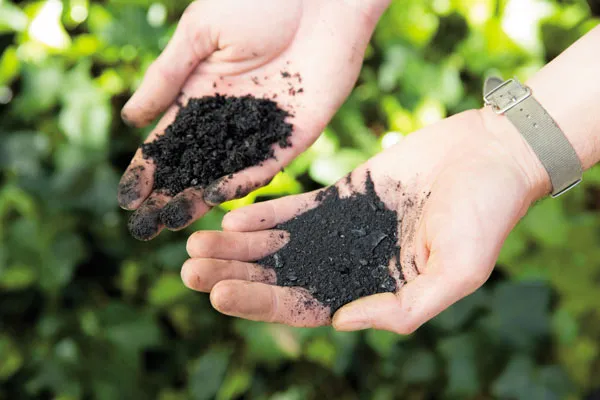
First, the color is darker and more uniform, often with a brownish-black hue. The texture is loose and crumbly, no longer sticky or clumpy. The smell of mature compost resembles that of forest soil or pleasant, moist earth; it no longer has the pungent odor of fresh manure or a sour, rotten smell.
You’ll also notice that the original ingredients are barely recognizable. It’s normal for a few fibers or small strands to remain, but the mixture should be relatively uniform overall.
In terms of temperature, the compost pile is no longer abnormally hot but has cooled to nearly ambient temperature and has remained stable for several consecutive days. This is a sign that the active decomposition phase has passed and the compost has entered a more stable state.
If you want to be on the safe side, you can mix a little compost into the soil to test-sow some bean seeds or sprouts. If the seeds germinate well, the roots are white and healthy, and there are no signs of root burn, the product is likely safe to use.
How to use compost biochar for different types of crops
After completion The composting process using biochar, the next step is to use the correct dosage to maximize effectiveness without wasting any product.
Mix into the soil before planting vegetables
For leafy greens, herbs, or short-season crops, you can mix biochar compost into the topsoil before planting. A recommended ratio is 10% to 20% by volume in the planting bed or growing medium, depending on the soil’s initial fertility.
If the soil is already fairly good, just add a moderate amount. If the soil is low in organic matter or compacted, you can gradually increase the amount, but you should monitor the plants’ response each growing season.
Basal fertilization for fruit trees, ornamental plants, and industrial crops
For perennials, biochar compost is suitable for use as a base fertilizer when planting new plants or as a supplemental application around the tree canopy. It can be mixed with topsoil and then placed in the planting hole or spread around the root zone.
The amount depends on the size of the plant and the type of soil, but the general rule is to apply it in thin, even layers, then cover it with soil or mulch to retain moisture and stimulate microbial activity.
Combine with potting mix
This is a very effective method because biochar improves aeration in the pot while retaining moisture better than many lightweight growing media. You can mix biochar compost with processed coconut coir, charred rice husks, clean soil, and a small amount of other drainage material.
The typical mixing ratio ranges from 10% to 25% of the total growing medium, depending on the plant type. Plants that prefer well-aerated roots, such as flowers, foliage plants, and many types of potted vegetables, will respond quite well.
Dosage Information
Although compost biochar is very beneficial, you shouldn’t apply too much right from the start. Begin with a moderate amount, and monitor the plants’ growth, the soil’s moisture retention, and your watering frequency. Once you have a good understanding of your garden’s conditions, you can gradually optimize your application over the course of each growing season.
Common mistakes when composting with biochar
Many failed composting batches are not due to poor-quality biochar, but rather to improper handling. Below are the most common mistakes.
Use biochar that has not been moistened or activated: Dry biochar is highly absorbent, which can lead to localized moisture shortages in compost piles and generate dust. When applied directly to plants, it may also cause temporary nutrient retention.
Using too much biochar: Many people think that more is better, but biochar should only be used as a supplementary ingredient. Too much can make the compost pile dry, light, slow to heat up, and create an imbalance between carbon and nitrogen.
Excessive humidity leads to anaerobic conditions: This is the primary cause of foul odors in compost piles. When the material is too wet, the number of aerobic microorganisms drops sharply, and the decomposition process takes an unfavorable turn.
Lack of regular mixing: No matter how effective the microbial inoculant is, if the compost pile isn’t supplied with oxygen evenly, decomposition will still be slow. The inner layers are prone to compaction, localized moisture buildup, and uneven decomposition.
The raw materials are too large or contain too many impurities: Large branches and leaves, uncut straw, sawdust mixed with chemicals, or inorganic waste will significantly reduce the quality of the compost.
Identifying these issues early will allow you to correct them during the composting process, rather than waiting until the end to discover that the compost isn’t up to standard.
Tips for Improving Composting Efficiency and Quality
If you want your biochar compost to mature faster and be more stable, you can try the following practical tips.
First, chop the organic materials into small pieces before composting. Grass, leaves, vegetables, and straw will have a larger surface area if cut into short pieces, which helps microorganisms break them down much more quickly.
Second, you can add a small amount of rice washing water, diluted banana juice, or a properly dosed microbial product to boost microbial activity. However, these should be used in moderation. The goal is to support the composting process, not to make the compost pile too damp or too nutrient-dense, which can lead to odors.
Third, always protect the compost pile from rain and direct sunlight. Heavy rain causes the compost pile to become waterlogged, washes away nutrients, and causes the biochar to become overly saturated with water. Prolonged exposure to intense sunlight, on the other hand, causes the surface to dry out quickly, which inhibits microbial activity.
Fourth, keep the compost pile at a moderate size. A pile that is too small has trouble retaining heat, while a pile that is too large is difficult to turn evenly. For a household, a pile measuring about 0.8 to 1.2 meters on each side is usually easy to manage.
Finally, record the ingredient ratios, the amount of biochar, the number of turning days, temperature conditions, and the completion time. This is a very effective way to optimize future composting batches based on your specific climate conditions, ingredients, and maintenance routine.
Conclusion
Apply correctly The composting process using biochar is a smart choice for home gardeners, small-scale farmers, and anyone interested in pursuing sustainable organic farming. When properly mixed and composted, biochar not only helps compost retain nutrients more effectively but also improves soil structure, increases aeration, maintains stable moisture levels, and creates an environment conducive to the growth of beneficial microorganisms.
These benefits are evident in stronger root systems, looser soil, more stable plant growth, and improved fertilizer utilization. More importantly, this solution effectively utilizes readily available byproducts, reduces reliance on chemical inputs, and contributes to building a sustainable soil system over time.
If you’re just starting out, there’s no need to go big right away. Start with a small batch, note the appropriate ratio, observe how the plants respond, and make adjustments as you go. After just a few tries, you’ll find that compost biochar is one of the most useful materials for improving soil quality and helping plants thrive naturally.